

There is a standard way to read an analyst report: find the top right corner, note who is in it, close the file. The Gartner Magic Quadrant for Business Orchestration and Automation Technologies, published on 14 September 2026, rewards staying longer, because the interesting part is the category itself. Gartner has put a name to the layer that holds AI agents, robots, systems and people together in one governed run, and has measured vendors against exactly that yardstick.
The numbers are simple. Gartner assessed twenty vendors. Four sit in the Leaders quadrant: Pega, Appian, UiPath and ServiceNow. The authors are Saikat Ray, Arthur Villa, Sachin Joshi, Adam Briggs, Tushar Srivastava and Mike Warren.
In short:
1/ BOAT names a whole category rather than renaming RPA - Gartner requires native orchestration of AI agents, governance over them and multiagent coordination,
2/ the entry bar is high on the commercial side too: hundreds of paying customers, at least twenty implementation partners, and presence across several industries and regions,
3/ Gartner credits the UiPath Platform with durable process execution in UiPath Maestro - process state survives infrastructure failure, and a running process can be paused, rewound, replayed and migrated,
4/ the report states the market direction plainly: by 2030, 70% of enterprises are expected to run on a consolidated platform orchestrating processes, agents, bots, APIs and people.
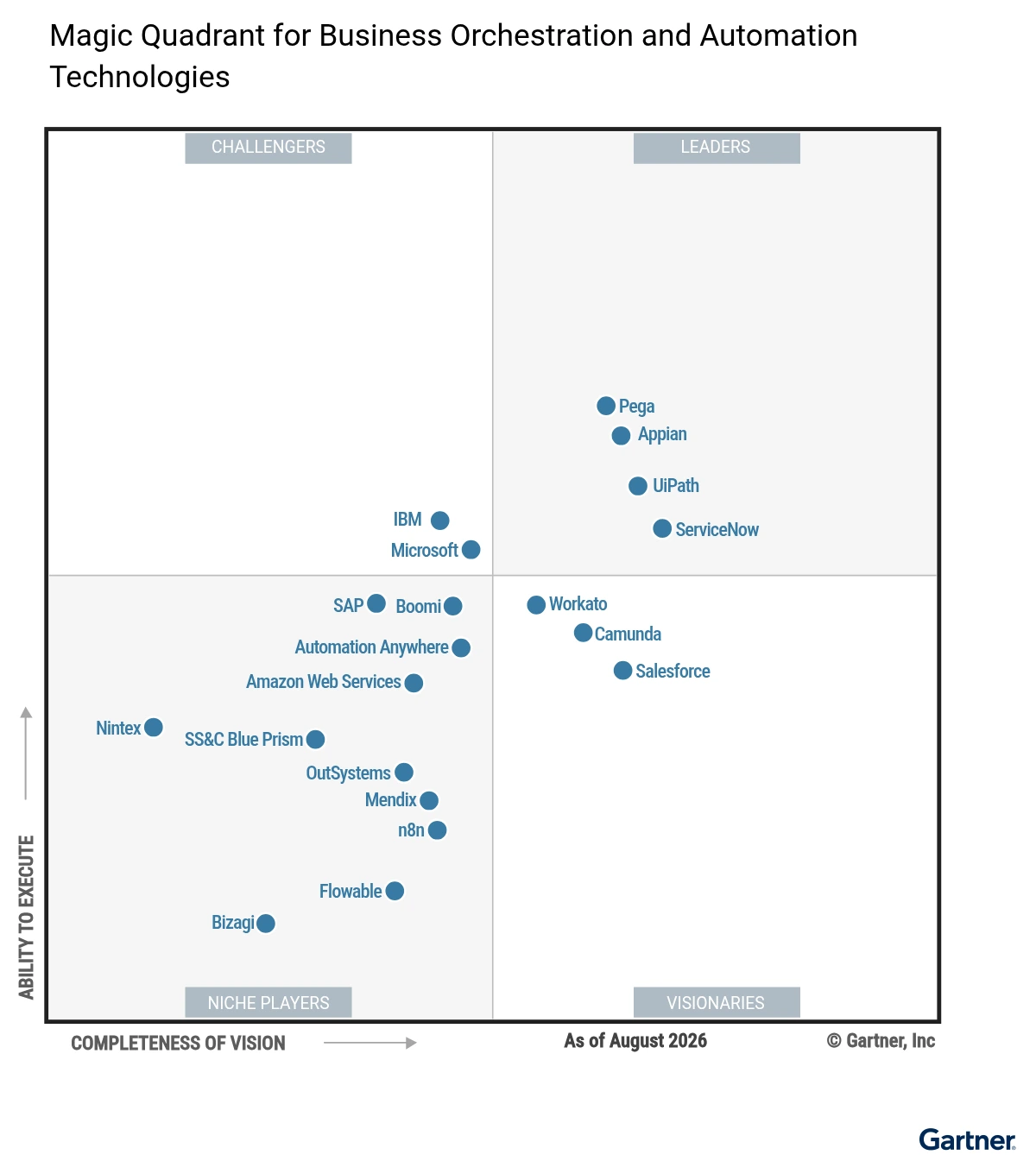
Figure 1 from the report: Gartner, Magic Quadrant for Business Orchestration and Automation Technologies, 14 September 2026. Reproduced as published, unmodified.
What BOAT is, and why the category exists
The acronym stands for Business Orchestration and Automation Technologies. Gartner describes the category as a consolidated platform that orchestrates and automates disparate business processes and tasks, with varying degrees of autonomy and complexity, across enterprise systems. Two words carry the weight: consolidated and disparate. Task automation has spread across a dozen tools in most organisations, and BOAT is the answer to the question of who runs all of it.
The entry bar is strict. A platform must provide native AI agent orchestration, governance, life cycle management and multiagent coordination. It must support agent interoperability through open protocols including Model Context Protocol and Agent2Agent. It must run long-running, stateful process orchestration, connect over APIs and events, emulate human work in the user interface and offer platform-wide governance. That list filters out single-task tooling.
On top of the feature bar sits hard commercial arithmetic. A vendor must show at least 300 paying customers of the assessed product, or 10,000 customer logos in total, or 45% year-over-year revenue growth in the BOAT area. It must also show at least twenty implementation partners, plus adoption across two industries and two major regions. That last condition says more about the market than it looks: Gartner treats partner availability as part of the product, because a platform of this class arrives together with a team that knows it.
The report states the scale of the shift plainly. Gartner’s strategic planning assumption is that by 2030, 70% of enterprises will move to a consolidated automation platform orchestrating business processes, AI agents, bots, APIs and human actions, up from 10% today. The BOAT market itself is estimated to exceed USD 34 billion by 2030. This is not a niche, it is the direction enterprise automation is taking.
What Gartner credits UiPath with
The assessed platform is the UiPath Platform, and three themes run through the strengths.
Innovation. Gartner notes that UiPath expanded beyond RPA into document processing, process intelligence and testing, and is now extending that track record into orchestration. For a company that already runs robots the practical consequence is straightforward: new capability is added on top of the existing investment. A working robot becomes a step inside a larger orchestrated process.
Ecosystem. A large enterprise customer base, implementation partners, technology alliances and trained practitioners on the market. It reads as a dull argument right up to the week you need a second consultant on a project within a fortnight. Then it becomes the most important one.
Durable process execution. This is the most concrete part of the write-up and it concerns UiPath Maestro. The engine persists the state of a long-running process, guarantees that each step executes once, and can pause, rewind, replay and migrate a process while it is running. In practice, a process lasting weeks, months or years survives external infrastructure failure, version changes and changes to the workflow itself, without losing state and without repeating completed work. Anyone who has run a claims case or a customer onboarding in a tool that restarted from zero knows what that single property is worth. We wrote about the control layer over that kind of process in our piece on human-in-the-loop gates in UiPath Maestro.
Two further elements appear in Gartner’s description of the platform: UiPath Autopilot for AI-assisted development, and the UiPath AI Trust Layer as a secure path to model endpoints.
What this position means for your automation programme
Gartner lists the use cases the BOAT category was defined around, and the list reads like the queue sitting in most large organisations.
Case management with knowledge agents. A claim, a credit application, a service case - work that has its own state, its own lifetime and a dozen possible paths. The agent prepares and suggests, a person approves, the platform makes sure nothing is lost along the way. We deliver this as case management.
Long-running flows across multiple systems. An order that travels through ERP, the warehouse, the carrier and finance, and has to survive every one of those boundaries. This is exactly the scenario where durable execution in UiPath Maestro stops being a datasheet line and starts showing up in the numbers.
Coordinating agents from several vendors under one governance layer. An agent in one tool, an agent in another, a robot in a third. A BOAT layer gives them a shared registry, shared entitlements and a shared audit trail instead of several independent islands.
Universal orchestration. Agents, people, robots and tools in one run, with one place that shows what is happening. That is what “consolidated” means in Gartner’s definition.
One more thread matters in our market. Most of the processes described here touch SAP at some point - a purchase order, an invoice, supplier data, a service request. SAP was assessed in the same Gartner report, which means both platforms we work with daily were measured against one yardstick. That is a comfortable position for you: we can show what UiPath brings to a specific process and what the SAP automation layer brings with SAP Build Process Automation and SAP Joule Studio, then match the choice to the business need and to what already sits in your landscape, rather than to whose partner we are. On a project it means our SAP team joins the automation team at the table, not after it.
How we start at SNOK
We are a UiPath Platinum Partner and a UiPath Agentic Automation Fast Track Partner - the scope is on our UiPath partnership page, and all our authorisations sit on the partnerships page. In practice a partner tier means a support path to the vendor, licences bought together with the implementation, and consultants whose certifications are renewed every year.
An orchestration programme always starts the same way, in three steps.
Pick the process that genuinely pays for the change. Candidates come from process mining rather than from the process owner’s conviction. Execution data shows where the volume, the waiting time and the repetitive work actually sit.
Build the first end-to-end run. Execution and integrations sit within business process automation, long-running orchestration runs on UiPath Maestro, and inbound paperwork is handled by document understanding.
Protect what already works. Regression after every change is covered by agentic testing, so each new stretch of the process is added without putting the previous ones at risk.
The Magic Quadrant recognition belongs to UiPath. For you it is a signal that the category has been named and measured, and that the platform we work on holds a strong position in it. The shortest way to test that in your own environment is one process and one end-to-end run. If you already have a candidate in mind, book a conversation about picking the first process - you will leave it with a set of selection criteria and a clear idea of what to look for in your execution data.
Sources
- Gartner, Magic Quadrant for Business Orchestration and Automation Technologies, 14 September 2026, ID G00844491, by Saikat Ray, Arthur Villa, Sachin Joshi, Adam Briggs, Tushar Srivastava and Mike Warren.
- The licensed reprint is made available by UiPath: report page.
- UiPath announcement of the recognition, 18 September 2026.
GARTNER is a registered trademark and service mark, and MAGIC QUADRANT is a registered trademark of Gartner, Inc. and/or its affiliates in the U.S. and internationally and are used herein with permission. All rights reserved. Gartner does not endorse any vendor, product or service depicted in its research publications and does not advise technology users to select only those vendors with the highest ratings or other designation. Gartner research publications consist of the opinions of Gartner’s research organization and should not be construed as statements of fact. Gartner disclaims all warranties, expressed or implied, with respect to this research, including any warranties of merchantability or fitness for a particular purpose.