

For many organisations Kubernetes is no longer a project. It is infrastructure, and the hard part has moved from getting clusters running to keeping them consistent across clouds, data centres and remote sites. The Gartner Magic Quadrant for Container Management, published on 2 September 2026, describes the market in exactly those terms.
Gartner assessed sixteen vendors and placed seven in the Leaders quadrant, SUSE among them. There are no Visionaries in this edition. The Leaders, listed alphabetically, are Alibaba Cloud, AWS, Google, Huawei, Microsoft, Red Hat and SUSE. Gartner does not rank vendors within a quadrant, so the order carries no meaning. The report is by Dennis Smith, Tony Iams and four other analysts.
Key points:
1/ Gartner sees a mature market in which results depend on a consistent way of governing clusters, policy and security across on-premises, cloud and edge environments.
2/ The inclusion bar is commercial as well as technical: a baseline of USD 50 million in annual revenue from the offering (USD 15 million on an alternative route) and production customers in several regions.
3/ Gartner lists three strengths for SUSE: management of mixed Kubernetes distributions from a single control plane, a strong edge position built on K3s, and sovereign capabilities that combine European ownership with strong technical capabilities.
4/ According to SUSE’s own announcement, this is its third consecutive year in the Leaders quadrant.
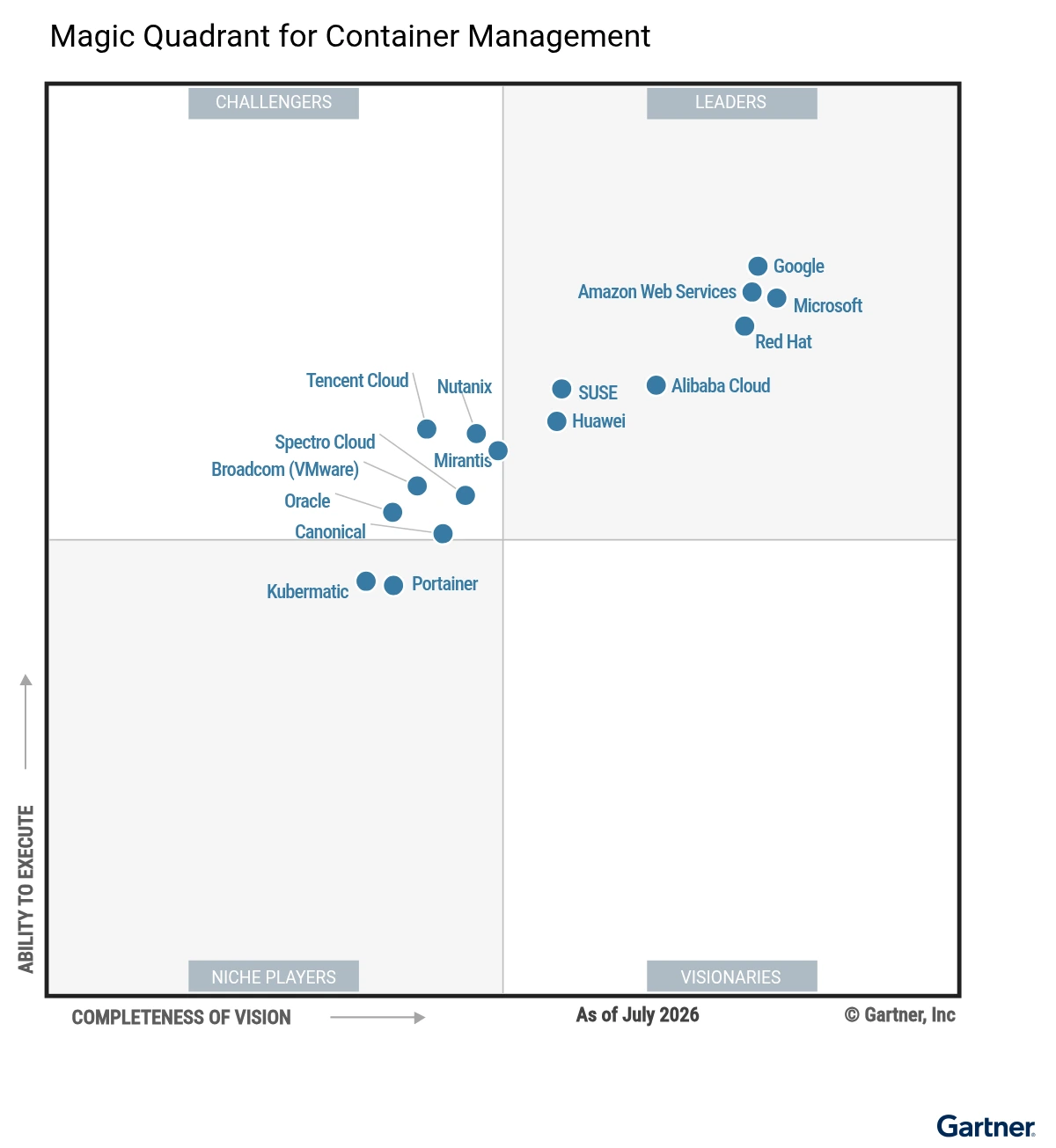
Figure 1: Magic Quadrant for Container Management. Source: Gartner (September 2026), reproduced without changes. This graphic was published by Gartner, Inc. as part of a larger research document and should be evaluated in the context of the entire document. The Gartner document is available from SUSE.
Gartner’s view of the market
Gartner defines container management as software that deploys and operates containerised workloads and the resources around them, under central governance of policy and security. Mandatory capabilities include orchestration and scheduling, a container runtime, an artifact registry, routing and networking, a service catalogue, a management interface and API access. Fleet management, platform engineering support, policy and governance, image supply chain security, and support for virtual machines and AI workloads are listed as optional.
The market overview matters more than the definition. Gartner describes a shift from innovation to practical optimisation. Savings expected from containers are often absorbed by growing operational overhead, and proprietary add-ons from vendors erode portability. Demand for hybrid and multicloud deployments is strong, but lock-in still holds organisations back. Gartner also observes that organisations perform better when support is centralised in a platform engineering team rather than spread across application teams. For an IT leader, the open question is less about running Kubernetes and more about who governs the estate and to which standard.
The inclusion criteria show how far the category has consolidated. A vendor needed at least USD 50 million in GAAP revenue from its container management offering, 50 paying production customers and at least five customers in each of three of seven regions. An alternative route required USD 15 million in revenue, 15 net new customers in 2025 and three customers in each of two regions. The offering also had to be available without mandatory professional services, with first-line support provided by the vendor, including for bundled open source components.
SUSE’s strengths according to Gartner
Gartner calls the SUSE portfolio extensive and flexible. SUSE Rancher Prime sits at the centre: a management platform for hybrid, multicloud and edge environments. It is backed by two distributions, RKE2, a hardened Kubernetes for highly regulated environments, and K3s, a lightweight distribution for resource-constrained sites. SUSE Virtualization combines virtualisation, Kubernetes orchestration and storage in one stack.
Gartner names three strengths.
Mixed distributions under one control plane. Rancher manages a wide range of Kubernetes distributions whether clusters run on-premises, in public cloud or at the edge. Gartner’s point is that an organisation can pick a different provider or distribution for each use case without paying for it in fragmented tooling and duplicated skills.
Edge with K3s. K3s exposes the full Kubernetes API in a small footprint. Platform teams can extend the governance and security policies they apply in the data centre to factory floors and branch offices without significant hardware spend.
Sovereignty. Gartner highlights SUSE’s European ownership, combined with strong technical capabilities, as an advantage for buyers who prioritise sovereign solutions, reducing some geopolitical supply chain risk and simplifying data residency requirements such as GDPR. A vendor’s ownership is one factor in that assessment, not a substitute for it. Whether a deployment meets GDPR, NIS2 or DORA depends on its architecture and on the operating processes around it.
Questions to settle before choosing a platform
Gartner itself notes that a Leader is not the best choice for every use case. The report is more useful as a checklist of the questions that should precede a decision.
Mixed estates. When some clusters run on a hyperscaler, some in your own data centre and some were left behind by past projects, the first task is visibility: where each cluster runs, which version, who has access and which policies apply. Tool selection comes after that.
Remote sites. Plants, warehouses and branches rarely have a platform engineer on site, yet their clusters must stay up and be patched remotely. K3s was designed for this case.
Data residency and vendor dependence. In regulated industries, the vendor’s ownership and the location of operational control are often part of the risk assessment. Gartner names this explicitly as a SUSE characteristic.
Virtual machines alongside containers. Changes in virtualisation licensing have pushed many organisations to review their estates. SUSE Virtualization runs virtual machines and containers on one platform. We look at the SAP side of this in VMware or KVM for SAP.
SUSE also sells a separate product, SUSE Rancher for SAP applications. The Magic Quadrant does not assess it, so we treat its capabilities as vendor claims and validate them in each project.
How SNOK approaches a container platform
SNOK is a SUSE Gold Partner. The scope of the partnership is described on our SUSE page, and our other vendor relationships on the partnerships page.
Our container platform engagements follow three steps.
Inventory. We establish how many clusters exist, which distributions they run, where they are hosted, who maintains them and which workloads are critical. This sits within IT advisory and integration, and the findings often change the original brief.
A pilot on one management layer. We bring a few clusters of different types under a single management layer and agree the success criteria in advance: versions, policies, access control and update cadence.
Hardening and operations. Configuration hardening, access policy and continuity fall under cybersecurity. Where SAP systems run on the platform, SAP Basis 24/7 covers them as well. Running language models on your own clusters is part of our LLM on-premise offering.
The Magic Quadrant position is SUSE’s. What it confirms for buyers is that container management is now judged on consistent governance, portability and sovereignty, the same criteria that should shape an internal platform decision. A cluster inventory and a pilot on a sample of the estate test those criteria against your own environment. To discuss an inventory, contact us.
Sources
- Gartner, Magic Quadrant for Container Management, 2 September 2026 (corrected 3 September 2026), ID G00841470, by Dennis Smith, Tony Iams and four others; accessed 1 October 2026.
- Licensed reprint provided by SUSE: SUSE report page, accessed 1 October 2026.
- SUSE, SUSE Recognized as a Leader in 2026 Gartner Magic Quadrant for Container Management, 8 September 2026, accessed 5 October 2026.
GARTNER is a registered trademark and service mark, and MAGIC QUADRANT is a registered trademark of Gartner, Inc. and/or its affiliates in the U.S. and internationally and are used herein with permission. All rights reserved. Gartner does not endorse any vendor, product or service depicted in its research publications and does not advise technology users to select only those vendors with the highest ratings or other designation. Gartner research publications consist of the opinions of Gartner’s research organization and should not be construed as statements of fact. Gartner disclaims all warranties, expressed or implied, with respect to this research, including any warranties of merchantability or fitness for a particular purpose.