

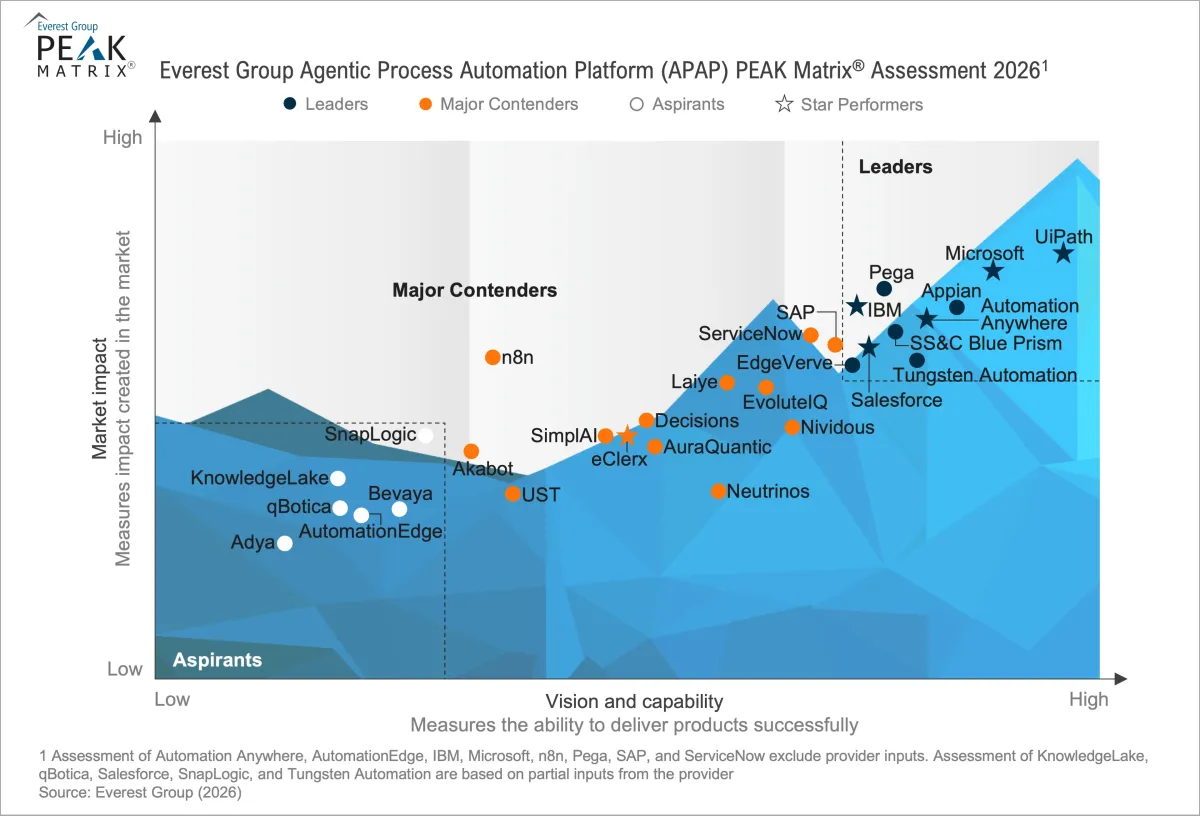
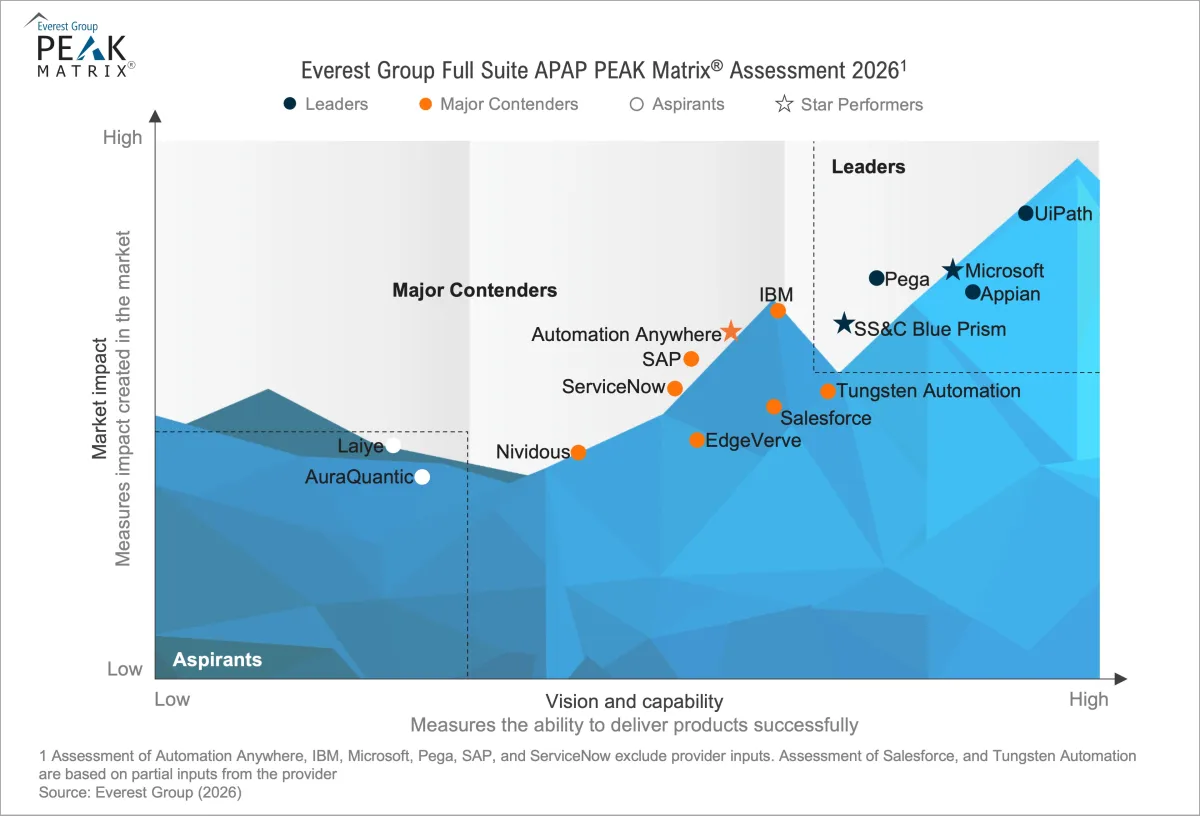
Everest Group has taken a close look at 29 platforms that bring AI agents together with robots, integrations and human work. On its Agentic Process Automation Platform (APAP) PEAK Matrix® Assessment 2026, one dot sits in the top right-hand corner, furthest along both dimensions. It belongs to UiPath. The picture repeats in the Full Suite APAP assessment, in which Everest Group assessed 15 of the 29 providers: UiPath holds the highest position in the Leader group.
As a UiPath Platinum partner, we are pleased to see it. We work with the platform every day and have watched it grow from a task automation tool into a platform that runs entire processes. Autumn 2026 shows the analysts see the same thing. Before the APAP report, Everest Group named UiPath a Leader and a Star Performer in its Process Orchestration Products PEAK Matrix® Assessment 2026, and UiPath is a Leader in The Forrester Wave: Adaptive Process Orchestration Software, Q3 2026, as we covered in UiPath named a Leader in The Forrester Wave for adaptive process orchestration.
What Everest Group assessed
The report, published on 14 October 2026, maps a market that until recently had no name of its own. An APAP, or Agentic Process Automation Platform, combines AI agents with rule-based automation: RPA, API integration, intelligent document processing and low-code tooling. Everest Group also looked at interoperability through MCP and A2A, and at agent governance, observability and security.
Full Suite APAP adds two layers on top: process orchestration and process intelligence, meaning an evidence-based view of how processes actually run. It is a test of completeness across the process lifecycle, from discovery to measuring the outcome.
Every platform is placed on two dimensions. The horizontal one, vision and capability, reflects the ability to deliver the product: strategy, technology capability, ease of deployment, engagement and commercial model, and support. The vertical one, market impact, covers the number of clients, revenue and its growth, the diversity of deployments and the value delivered to clients, judged partly on their own feedback. In both assessments UiPath sits furthest along both dimensions at once.
Why UiPath sits so high
The full rationale for the APAP positions sits in the paid report. The strengths Everest Group cited in its Process Orchestration Products assessment, together with what we see on projects, point to five reasons.
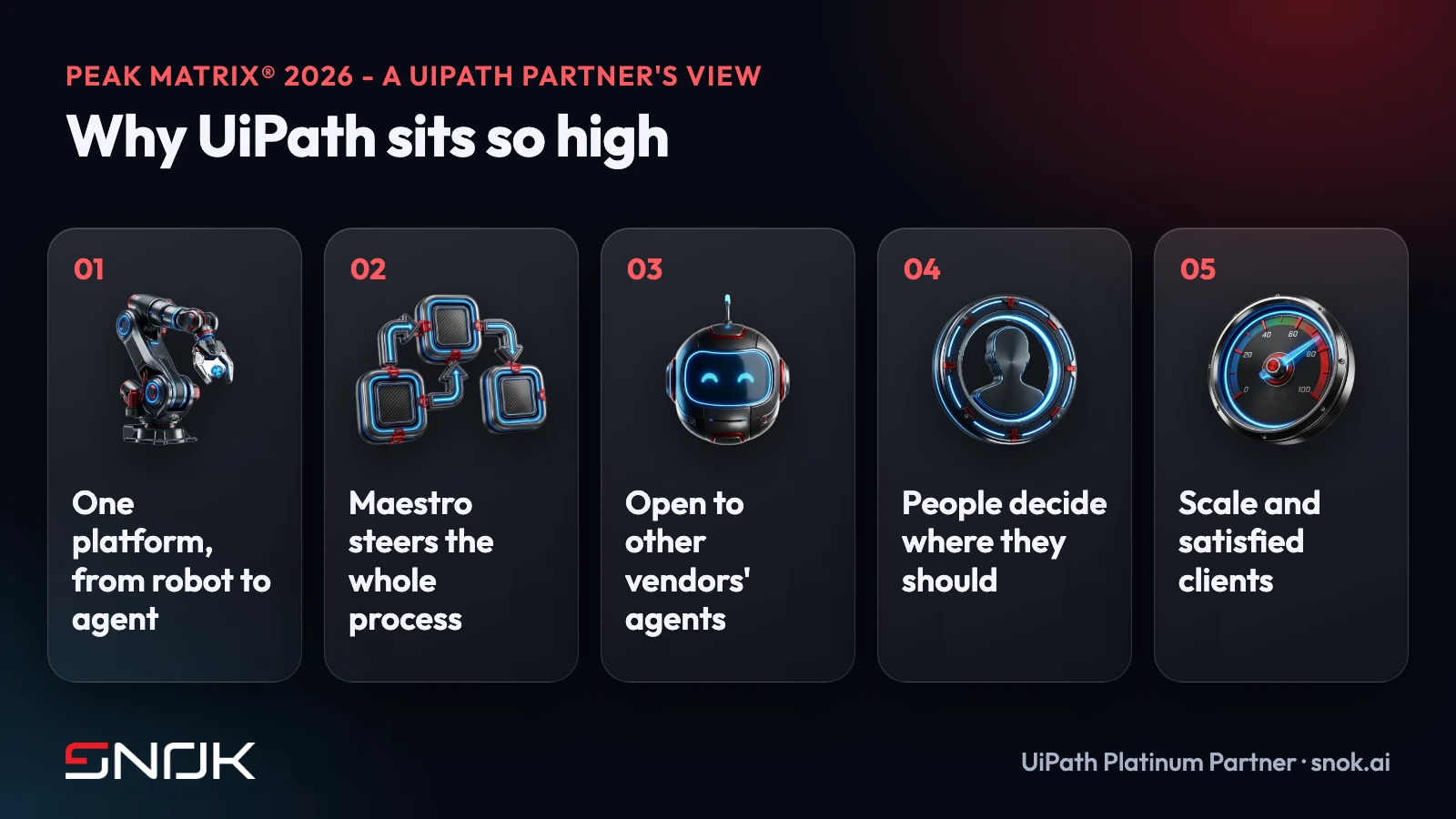
One platform, from robot to agent. An agent built in Agent Builder, an RPA robot, a system integration and a document model all work in the same environment, under shared governance and with one view of what is happening in the process. An organisation with robots already in production does not start over. It adds agents to processes it already knows.
Orchestration as a layer of its own. UiPath Maestro runs processes that take days or weeks, keeping track of sequence, deadlines, exceptions and case state. According to UiPath’s announcement of 8 October 2026, Everest Group singled out the coordination of agents, robots, APIs, documents and people in a single orchestration layer with shared governance and observability. Everest Group awards the Star Performer designation to providers whose year-on-year movement on both dimensions falls in the top quartile of the group and who show the most top-quartile parameter improvements, with at least one each on market impact and on capability. It measures momentum, not market position. We explain the tool itself in UiPath Maestro explained.
Open to other vendors’ agents. Maestro connects to external agents and tools through MCP. An organisation that already runs AI assistants in its office suite, agents embedded in business applications and models of its own can bring all of them under one orchestration layer instead of adding another island. We looked at the cost of lock-in in Vendor lock-in in 2026.
People decide where they should. DMN decision rules, Action Center for approvals and exceptions, and AI Trust Layer policies for models and data set the boundaries within which an agent operates, boundaries we design together with the business. Everest Group listed decision rules and Action Center among Maestro’s strengths.
Scale and satisfied clients. On market impact, which takes in the number of clients and their feedback among other things, UiPath sits highest in both APAP assessments. In the Process Orchestration Products assessment, Everest Group pointed to strong satisfaction among UiPath Maestro clients, including support and platform resilience. Agents therefore start from a foundation already running in production at a great many organisations.
Five questions for your automation programme
A Leader position narrows the shortlist. It does not tell you whether your processes are ready for agents, and Everest Group itself notes in its methodology that results may not be directly prescriptive for every buyer. The criteria behind the assessments do, however, make a useful checklist.
Do agents, robots, APIs and documents work within one process? An agent that classifies a complaint has to hand the case to a robot or call a system API, and the document in the attachment has to enter the process as data.
What steers a process that runs for days or weeks? An agent handles a step. Claims handling, supplier onboarding or month-end close need a layer that keeps hold of the whole - in UiPath, that is UiPath Maestro.
Where does a person approve the agent’s decision? An amount over a threshold, a low-confidence classification, personal data. We design those points before the agent is built, because adding them after go-live means reworking the process.
Can the platform handle agents and models from outside its own ecosystem? MCP and A2A decide whether orchestration can cover everything already running in the organisation.
Can you see what the agent did, and why? A decision record, data access policies and resilience testing against prompt manipulation are the evidence an organisation subject to NIS2, DORA or the AI Act needs when compliance is audited.
SNOK and UiPath
SNOK is a UiPath Platinum Business Partner and Gold Services Partner, and takes part in the Agentic Fast Track programme. In agentic automation projects we start from the process: we map how it runs, assign steps to the agent, the robot, the integration and the person, and only then build the agents. Every project involving an AI agent goes through our AI security review, covering the agent’s permissions, its access to data and its resilience to prompt injection.
Most of our work falls into three situations. A company has RPA robots in production and wants to add agents where the robots currently stop at exceptions. A company has an AI agent pilot that works in isolation and never reached a production process. Or a company is starting from scratch and needs business process automation designed with agents in mind from day one.
If you would like to find out which of your processes is the right first agentic project, we would be glad to talk. More on how we work with the platform: UiPath at SNOK.
Sources
- Everest Group - Agentic Process Automation Platform (APAP) and Full Suite APAP PEAK Matrix® Assessments 2026 (accessed 1 November 2026)
- UiPath - announcement on the Everest Group Process Orchestration Products PEAK Matrix® Assessment 2026 (8 October 2026, accessed 1 November 2026)
- Everest Group - PEAK Matrix® Assessment and RFI Overview (accessed 1 November 2026)