

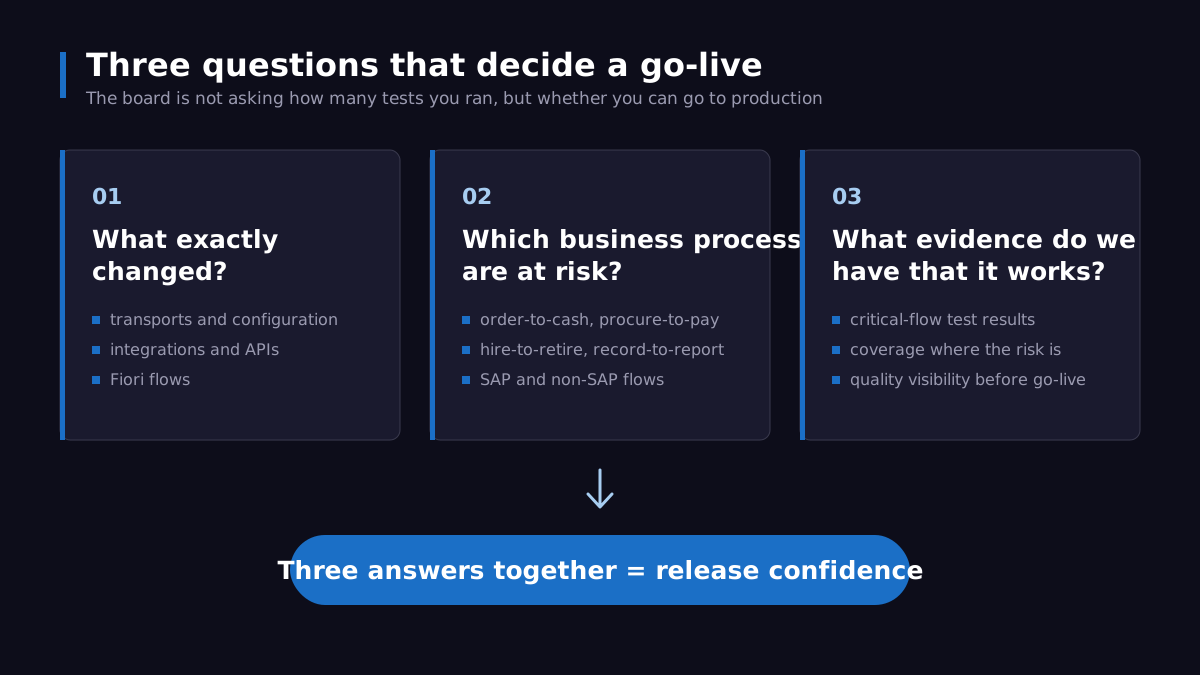
It is Friday afternoon, one week before the go-live of the next S/4HANA transformation wave. The board asks a single question: “are we going to production?”. And at that moment it turns out that nobody cares about the report with the number of executed tests. Three things matter: what exactly changed, which business processes are exposed by that change, and what evidence you have that the critical flows will work on Monday morning.
If the team cannot answer those three questions, the number of tests is irrelevant. That is the core of the thesis UiPath put forward in its recent article “Modern SAP testing is becoming a release-confidence problem”, summarising the webinar by Jeevan Koneti, author of the book “Mastering Quality Engineering for SAP S/4HANA”. The thesis: SAP testing has stopped being a QA problem and has become a release-confidence problem. We went through the material and layered our own experience from projects where SAP and UiPath meet in a single landscape.
Why S/4HANA changes this
It is not about the size of the migration. It is about the pace of change - in business processes, integrations, data, Fiori interfaces and dependent systems. A single transport, a configuration change or a Fiori flow correction can simultaneously touch finance, procurement, supply chain, HR and customer service. Regression cycles get longer exactly when the business expects faster delivery.
In such an environment, testing positioned at the end of the cycle as the last checkpoint simply cannot keep up. The questions a quality team must answer have stopped being tester questions and have become business questions. It is the same shift in perspective we described when writing about the role of UiPath in S/4HANA transformation.
Six lessons from the webinar - and what they mean in practice
1. Testing must match the complexity of the SAP landscape
When you validated a narrow set of transactions in a single system across two releases a year, testing could be handled manually. S/4HANA programmes look different: a mix of legacy environments, new S/4HANA capabilities, Fiori experiences, APIs, third-party applications and processes cutting across many systems at once.
That changes the very definition of the task. Modern SAP testing validates complete business processes, not individual screens. Practical questions worth asking: which processes are most exposed by a specific change, where you have low test coverage and high manual effort, which flows cross the boundary between SAP and non-SAP systems. The answer is rarely “let’s test more of everything”. The better answer is a testing model that reflects how your landscape actually works: connected, business-critical and constantly changing.
2. Quality engineering should be proactive, not reactive
In large transformation programmes, quality engineering plays a strategic role: it protects business continuity while allowing the organisation to accelerate. Instead of asking only whether a test passed, the QE team helps answer bigger questions: what changed, which process may be affected, what evidence stakeholders need before go-live, which tests to automate, which to reuse and which to retire.
Understood this way, QE stops being a project phase and becomes a transformation capability - a structured way of managing risk and making release decisions with greater confidence.
3. Test data is the biggest brake on pace
SAP testing often slows down before execution even starts. Teams know which scenarios they want to validate, but cannot quickly find, refresh, mask or recreate the right data. And weak test data means weak confidence: tests pass but do not reflect real business conditions. If data preparation depends on a few subject-matter experts, regression cycles become hard to repeat and scale.
A mature model treats test data as a first-class discipline: reusable approaches to preparing realistic scenarios, support for automated regression and less dependence on scarce experts - especially in the processes carrying the biggest release risk, such as order-to-cash, procure-to-pay, hire-to-retire and record-to-report.
4. Continuous test automation instead of one-off scripting
Manual SAP regression means long cycles, uneven coverage and a heavy burden on business users. That model does not survive frequent change and successive transformation milestones. The alternative is a practice of continuous automation: reusable components, end-to-end process validation, tests run earlier and more often, connected to the release process and DevOps.
This is particularly important with S/4HANA, because the work does not end at go-live. The environment keeps changing - through updates, integrations, configuration corrections and further transformation waves. Automation delivers the most value when it becomes a way of managing continuous change, not preparation for a single milestone. We have verified this in practice: in one of our UiPath Test Cloud implementations we cut testing time by 75% with a 529% ROI.
5. Risk-based beats volume-based
More tests do not automatically mean more confidence. Release confidence comes from knowledge: what changed, which processes are affected, which risks need attention first. Instead of treating every regression cycle as a broad, manual retest of everything, prioritise tests by business impact, process criticality, real usage, change history and existing automation coverage.
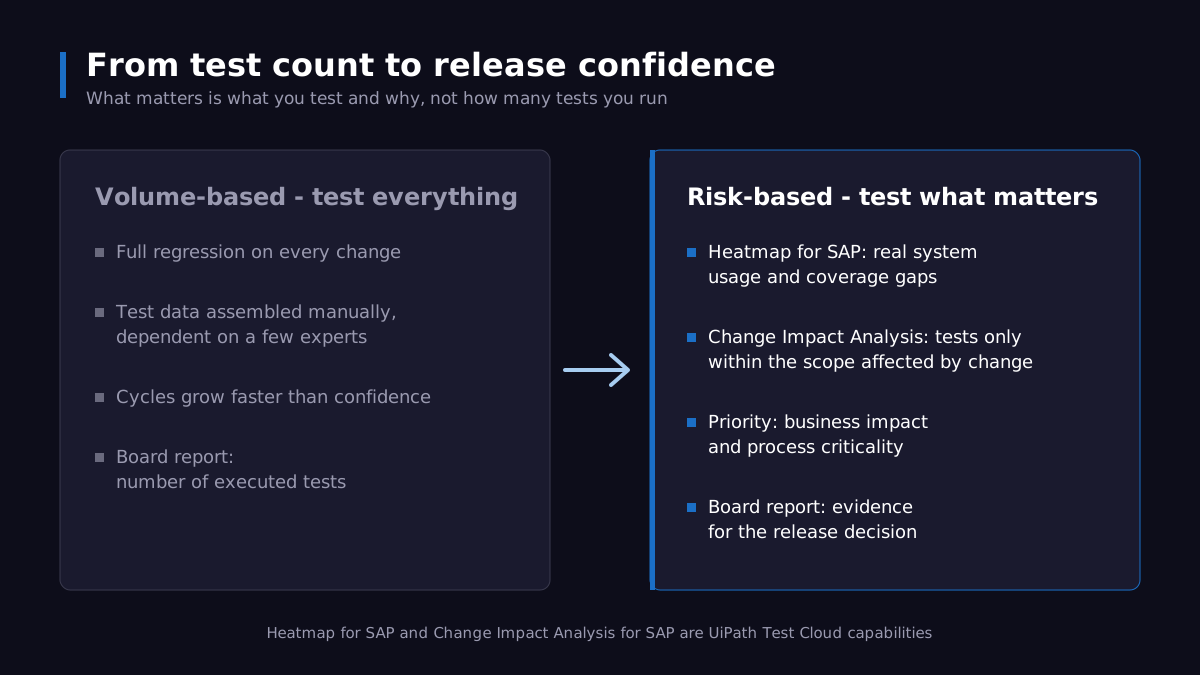
On the tooling side, two UiPath Test Cloud capabilities support this: Heatmap for SAP shows actual system usage and gaps in test coverage, while Change Impact Analysis for SAP narrows the testing scope to the areas genuinely affected by a change. The effect: a shift from “test as much as possible” to “test what matters, and have the evidence for it”.
6. AI and agentic testing reduce effort, not accountability
AI can accelerate almost the entire testing cycle: test case design, requirements analysis, data preparation, automation creation, results analysis and coverage assessment. But the key change is not sprinkling AI onto tests - it is using AI in a supervised way, so testers can handle greater complexity with less manual effort.
That is how agentic testing in UiPath Test Cloud was designed: AI agents support specific testing tasks, while judgement, oversight and the release decision remain with testers, automation engineers and quality leaders. The goal is not to replace SAP testers or business experts with agents - it is leverage that lets people focus on the quality decisions that matter most. We wrote more about this in our piece on how agentic testing changes the very nature of tests.
Where to start - seven steps for an SAP leader
The S/4HANA transformation raises the bar for testing because it raises the cost of uncertainty. If we are to leave you with one list from this material, it is this one:
- Treat quality engineering as a strategic capability, not the final phase of a project.
- Prioritise tests by business risk and process criticality, not by volume.
- Strengthen test data management early - it is the most common brake we see.
- Build continuous automation for SAP and connected systems, not one-off scripts for a go-live.
- Use AI where it reduces manual effort and improves coverage.
- Keep humans accountable for judgement and release oversight.
- Give stakeholders clear visibility of quality before go-live - that is what the “go” decision is based on.
Our take
This UiPath article lands exactly where we work every day: the intersection of SAP and automation. S/4HANA testing is not a project to tick off - it is a capability an organisation builds once and consumes with every transport, every update and every next transformation wave. The number of executed tests was a good metric ten years ago. Today the metric is whether, on a Friday afternoon, you can answer the board’s question “are we going?” - with evidence, not with hope.
If you are planning an S/4HANA transformation, or your regression cycles are growing faster than your confidence in releases - let’s talk. We combine SAP Basis and UiPath (Platinum) competencies and will help you set up a risk-based testing model before your first failed go-live does it for you.
Sources: UiPath Blog, “Modern SAP testing is becoming a release-confidence problem” (published 8 July 2026, accessed 18 July 2026); UiPath webinar “Mastering Quality Engineering for SAP S/4HANA” (Jeevan Koneti).