

In companies running SAP, the master data conversation often starts with one question: should we buy SAP Master Data Governance? Since 7 May 2026 there is one more name on the table, because that is when SAP completed its acquisition of Reltio. SAP’s portfolio now includes SAP MDG and Reltio, which also remains available as a standalone offering. Next to them stands our own solution, SNOK MDM.
At the level of core functions - validation, change governance, audit trail - these solutions have a lot in common. The choice is therefore decided elsewhere, by three questions rarely asked in the first meeting. Where can the solution run? What data will it cover? And how quickly will it deliver a first result?
SAP MDG - order inside SAP
SAP Master Data Governance emphasises governance, the process layer: change requests, approval paths, validation rules and audit trail. It works best where data is created and maintained primarily in SAP.
If your whole landscape runs on SAP S/4HANA and your priority is a change process run inside SAP, SAP MDG belongs on your shortlist. There is one condition: readiness for the process discipline the tool brings.
Reltio - a SaaS platform, in SAP’s portfolio since May
SAP describes Reltio as cloud-native, AI-native master data management that unifies and cleanses data from multiple sources in real time. It covers customers, products, suppliers, locations and employees, across both SAP and non-SAP applications. After the acquisition Reltio becomes part of SAP Business Data Cloud.
Reltio itself presents its product as a cloud SaaS platform. That is good news for organisations that want to buy a service rather than run infrastructure. It is less good for those whose security policy or regulator requires master data to stay in their own environment.
SNOK MDM - the flexible alternative
SNOK MDM is our own solution for master data management. It builds the authoritative record, the golden record, across the systems you already run, without replacing your ERP. It covers six domains on one platform: employees, customers, materials, suppliers, products and financial accounts. Ready-made connectors support SAP S/4HANA and SAP ECC, as well as Salesforce, Workday, Oracle Cloud ERP, Microsoft Dynamics 365 and Azure AD.
The key difference is where it runs. SNOK MDM can operate on-premise, in your own cloud environment or as a service - multi-tenant with per-client data isolation, or as a dedicated instance. Source code can be placed in escrow if your business continuity policy requires it.
The second difference is pace. We bring the first domain live in four to eight weeks, at a fixed price per phase and with acceptance criteria agreed before the start. Further domains are added on the same platform once the first result is confirmed. Your data and the agreed data model stay with you.
Three questions that decide the choice
Where must the data stay? If your security policy, auditor or regulator requires master data to remain in your own infrastructure, a platform delivered as SaaS will not meet that requirement. SNOK MDM runs where you decide.
What data should the solution cover? If everything is created in SAP and the priority is a change process inside SAP, SAP MDG is the natural candidate. If your data lives inside and outside SAP, across several domains, compare Reltio and SNOK MDM.
How quickly do you need a result and how do you want to pay for it? A platform programme paid by subscription is a different decision from a first domain live within weeks, at a fixed price per phase.
If these questions show that SAP MDG is the better choice, we will say so plainly. The options can also work together: SAP MDG governs changes in SAP, while SNOK MDM assembles the record from non-SAP systems and sends it back to SAP.
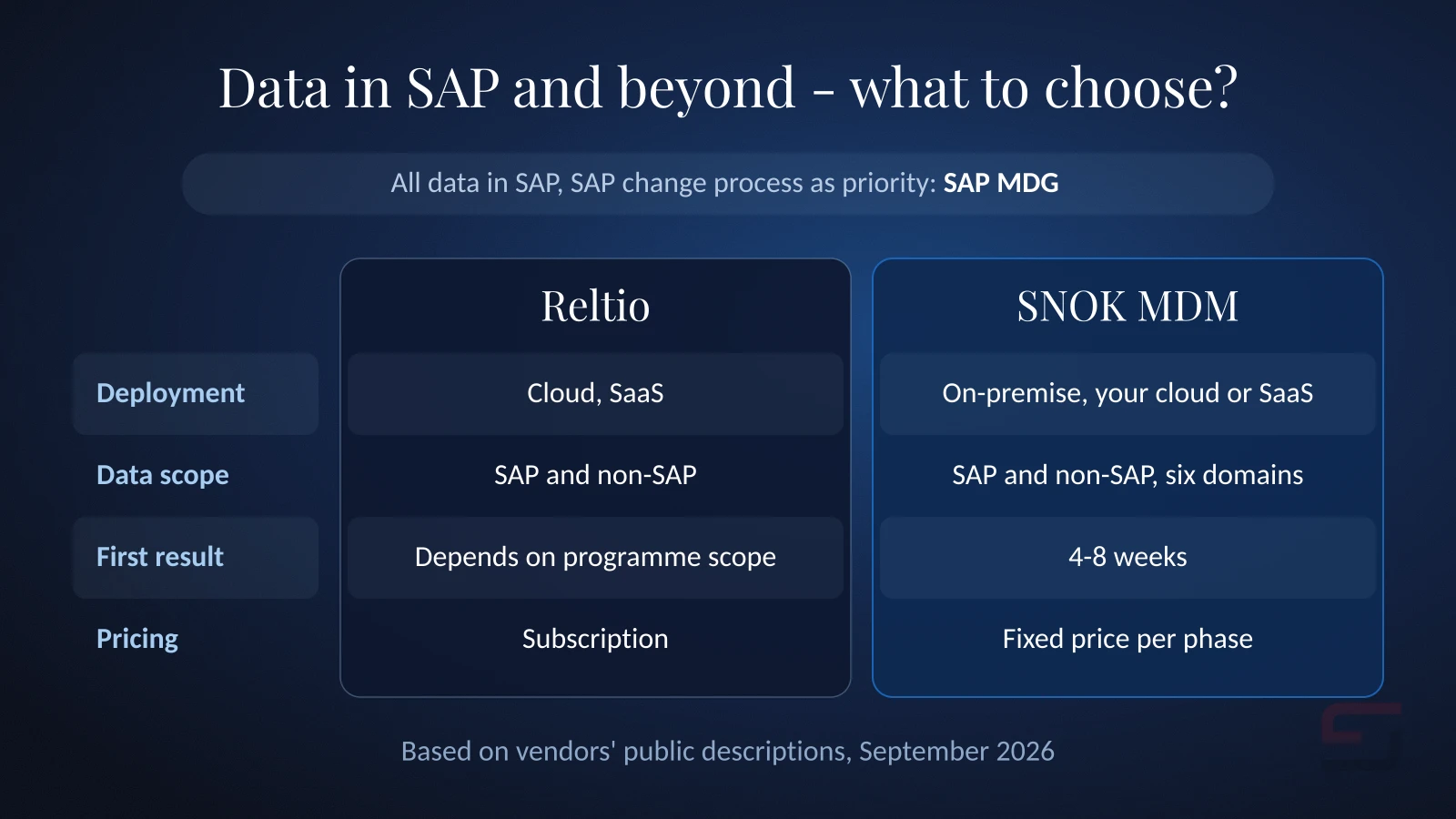
SNOK MDM and Reltio - based on vendors’ public descriptions, September 2026
Where master data extends beyond SAP
The most interesting cases begin where an obligation concerns a record that SAP holds only in part.
Supply chain under Poland’s national cybersecurity act. Essential and important entities that are not entered in the national register ex officio should file for entry by 3 October 2026. The amended act transposes the NIS2 directive and also requires supply chain security management. Yet an IT supplier is rarely one record: the contract sits with IT, the master file in the ERP, the assessment in the security team’s spreadsheet. One supplier record with its ownership hierarchy and verification history puts this in order before the auditor asks - and for supply chain security data, the option to deploy on-premise stops being a technical detail. Not sure whether the act applies to you? Start with our free KSC check.
ESG and the value chain. Some ESG reports and ratings require value chain data, including data collected from suppliers. The questionnaire often reaches them before anyone has established how many suppliers there really are. The same counterparty recorded five times gets five questionnaires and answers five times - or not at all.
Product. The material master lives in SAP, but composition, raw material origin or data for a digital product passport come from suppliers and from the engineering system. A product record that knows where each field comes from feeds SAP instead of competing with it.
HR. The same person exists in the HR and payroll system, in SAP, in the access directory and in the training system. Inconsistent deactivation after someone leaves can leave an active account in one of these systems. One person record as the source for granting and revoking access is a master data topic and a security topic at the same time.
Where to start
With a measurement, not with choosing a tool. On a sample from one domain we show how many records describe the same entity, how many have gaps in critical fields and where systems disagree. We described the scale of the issue in Polish companies in our report on master data in Polish enterprises.
Read more about the platform on the SNOK MDM page. A broader analysis of the MDM market after the acquisitions is in our August post. If you want to find out which solution fits your landscape, let’s talk.
Frequently asked questions
How do SAP MDG and Reltio differ? SAP MDG governs the creation and change of master data in SAP processes: change requests, approvals, validation and audit trail. Reltio is a SaaS MDM platform that unifies data from many sources, across SAP and non-SAP applications. Since 7 May 2026 both products belong to SAP, and Reltio also remains available standalone.
How does SNOK MDM differ from Reltio? Both cover SAP and non-SAP data across multiple domains. Reltio is presented by its vendor as a cloud SaaS platform. SNOK MDM can run on-premise, in the client’s cloud environment or as a service, with an optional source code escrow, and brings the first domain live in four to eight weeks at a fixed price per phase.
Can SNOK MDM be deployed on-premise? Yes. SNOK MDM can run in the organisation’s infrastructure, in its cloud environment or as a service, multi-tenant with data isolation or as a dedicated instance. The processing location is agreed before the project starts.
Which data domains does SNOK MDM cover? Six domains on one platform: employees, customers, materials, suppliers, products and financial accounts. Each domain has its own data schema, validation rules and approval workflow.
Can SAP MDG, Reltio and SNOK MDM work together? Yes. SAP MDG can govern the change process in SAP, while an MDM layer above the systems assembles the record from non-SAP systems and sends it to SAP.
Sources
- SAP, SAP to Acquire Reltio: Make SAP and Non-SAP Data AI-Ready, 27.03.2026, news.sap.com
- SAP, SAP Completes Acquisition of Reltio, 07.05.2026, news.sap.com
- Reltio, The Reltio Data Cloud, reltio.com
- Polish Ministry of Digital Affairs, A month left for self-registration in the KSC register, 03.09.2026, gov.pl (in Polish)
- SAP, SAP Master Data Governance documentation, help.sap.com