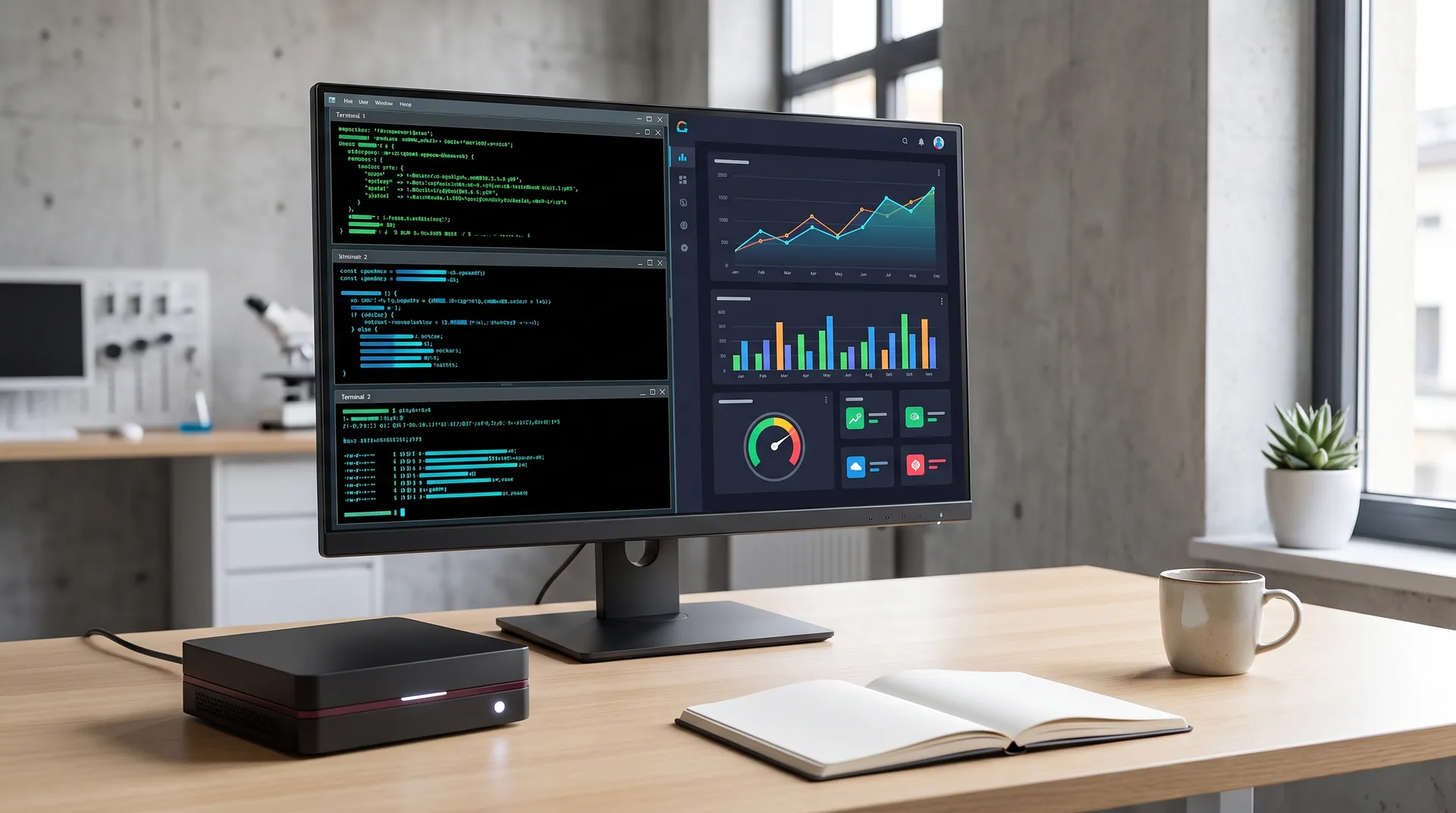

I rarely write about hardware. This time I am making an exception, because a machine passed through our lab that changes how you think about enterprise AI - and we managed to give it a proper workout before it moved on to a client.
The machine is the Lenovo ThinkStation PGX: the corporate take on the class of devices built around the NVIDIA GB10 Grace Blackwell superchip, the same family as the NVIDIA DGX Spark. From the outside it looks like a tidy mini PC. Inside is something that two years ago would have required a server rack: a computer designed exclusively for developing and running artificial intelligence.
What is inside
The configuration we tested looks like this (full specification: Lenovo Press):
- the NVIDIA GB10 Grace Blackwell superchip - CPU and GPU on a single package,
- 20 ARM cores (10x Cortex-X925 + 10x Cortex-A725),
- an NVIDIA Blackwell GPU with 5th-generation Tensor Cores,
- 128 GB of LPDDR5X unified memory shared between CPU and GPU, with 273 GB/s of bandwidth,
- an NVMe drive up to 4 TB with hardware encryption,
- 10 GbE networking plus a ConnectX-7 SmartNIC and Wi-Fi 7,
- NVIDIA DGX OS (Ubuntu on ARM64),
- all of it powered by a 240 W supply - less than a single gaming graphics card can draw.
The number that matters most is the 128 GB of unified memory. In a classic workstation a language model has to fit into GPU memory, which usually means 24-48 GB. Here the CPU and GPU share one pool - so a machine the size of a hardcover book runs models that until recently required a server costing six figures.
What we ran on it
We did not run benchmarks for their own sake. We built a complete working environment, the kind you would actually deploy at a client:
- an inference backend (Ollama and vLLM) serving models over a standard OpenAI-compatible endpoint,
- Hermes Agent by Nous Research - an open-source agent that connects to that endpoint, performs tasks with tools and builds its own memory,
- a set of local models: gpt-oss-120b as the flagship generalist, Qwen3-Coder 30B for code and agentic work, and gpt-oss-20b for fast, cheap tasks.
The first item is the one that impressed us most. A 120-billion-parameter model - a class that not long ago was reserved for the cloud - runs locally, smoothly and with sensible response times (actual speed depends heavily on the inference engine - an optimised stack can be several times faster than default settings). In a Mixture-of-Experts architecture only a fraction of the parameters is active per token, so despite its size the model takes roughly 60-65 GB in MXFP4 quantisation and leaves headroom for long context.
Three lessons from the lab
First: MoE beats dense. Large dense models (Llama 70B, for example) fit in memory comfortably but are slow in a single conversation - the 273 GB/s of memory bandwidth is the natural ceiling, which public benchmarks confirm as well. Mixture-of-Experts models sidestep that ceiling gracefully. On this machine the model’s architecture matters more than its raw size.
Second: this is a machine for agents, not for a single chat. The GB10 shows its strength under many parallel requests - which is exactly how AI agents and document-processing pipelines work. In batched workloads the device delivers many times the aggregate throughput of a single conversation. If you are planning to take agents to production, this is hardware cut for that scenario.
Third: fully offline genuinely works. The whole chain - model, agent, tools, memory - runs without a single packet leaving for the internet. For companies handling data under NDA, personal data or regulatory requirements (NIS2, DORA - both very much alive for EU businesses), this is not a curiosity. It is the answer to the question we hear most often: “how do we use AI without our data leaving the organisation?” We wrote about this approach when we described an AI factory for SAP without the cloud - the PGX is the same direction, in a form factor you can set up on a desk within an hour.
Who it is for
After these tests we see three natural use cases:
- Confidential AI on your own data. Analysing documents, code and data that cannot leave the organisation - a local model plus RAG over an internal knowledge base.
- A development environment for AI teams. Prototyping agents and pipelines without an API cost meter - once you own the hardware, the marginal cost of inference is zero.
- A first step towards private AI infrastructure. Before you invest in a full private cloud for enterprise workloads, the PGX lets you verify on real data whether local models can carry your use cases.
To be fair about the limits: this is not a machine for training large models, nor a replacement for the cloud where you need frontier-model quality. It is a device for inference, prototyping and agentic work - and in that role it is, in our view, the most interesting proposition in its price class today.
Verdict
The unit we tested has already shipped to a client - and frankly, we miss it a little. Machines that serve 120B-class models in this form factor, at a 240 W power draw, simply did not exist until now.
A desktop unit answers one question: can a local model carry your use case? Running that model inside your own infrastructure is a separate project - GPU server sizing, serving through vLLM, TGI or Ollama, RAG on a local vector database, answer-quality monitoring and an AI Security Review before go-live. That scope is set out on our on-premise LLM page.
If you are wondering what such an environment could look like in your organisation - from hardware selection through models to agents integrated with your processes - SNOK, an IT consulting firm from Warsaw and a Lenovo Platinum partner, helps take that road from test to production. Get in touch and we will show it live.