

I learnt to program by typing in listings from Bajtek, a Polish computer magazine, on a ZX Spectrum. Western magazines printed entire programs as columns of hexadecimal, and we typed those in too, with no idea what the code actually did. Nobody explained anything. One typo and the program would not run, and you had to hunt for the mistake yourself, line by line. Then came the Atari 800 XL, the first PCs and a long fascination with Apple computers. In the early 2000s I learnt SAP security the same way, by trial and error: in penetration tests, reviewing authorisations and reading logs, because courses and certifications barely existed. Today there is a Mac Studio on my desk running AI agents. In a few minutes they write code that once took ages of typing and fixing.
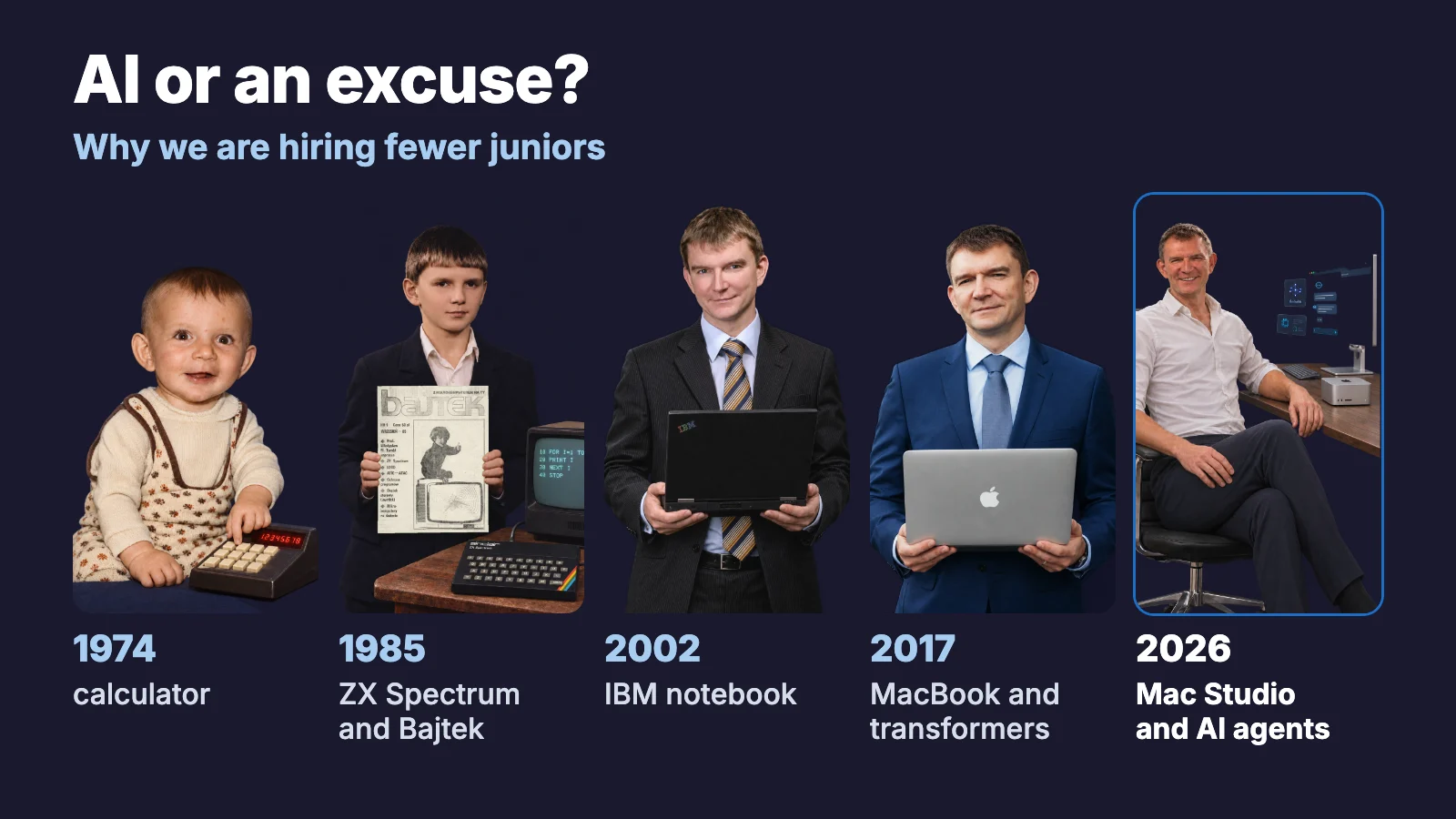
Portraits and props generated with the help of AI from the author’s archive photographs; the 1985 frame shows the cover of Bajtek issue 1, September 1985.
Every new tool took some of the drudgery off my hands, but it always left a place where I had to get stuck in order to learn something. For the first time, I have the impression that the tool takes the getting stuck away as well. An agent does not leave the typo for you to find. It finds it and fixes it.
A team at Anthropic tested this on programmers learning a new Python library. The group working with an AI assistant scored noticeably lower on a comprehension test than the group working alone, and the widest gap was in debugging. The authors write that cognitive effort, “and even getting painfully stuck”, is likely important for building mastery. That confirms the instinct of someone who grew up on printed listings. Which is exactly why I do not trust that instinct without reservation.
Researchers disagree on the cause
In Polish IT the number of job offers is growing, yet entry-level roles made up less than 5% of the ads on Just Join IT in 2025. According to No Fluff Jobs, in the first months of 2026 each junior opening drew 47 applications, against 19 for a senior one. In an EY survey, one in three companies in Poland said it was cutting back on hiring people without substantial experience.
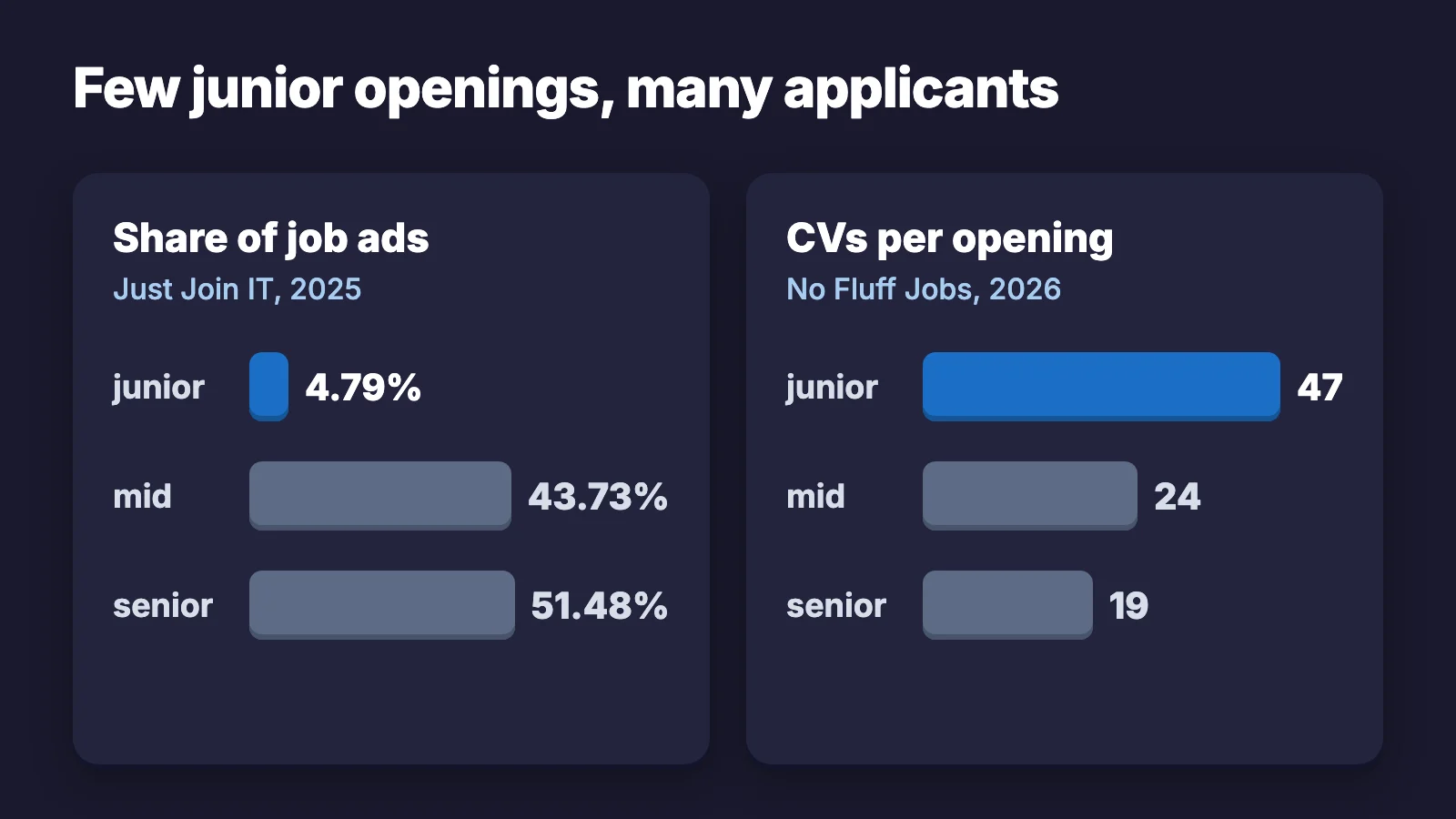
Sources: Just Join IT, IT Salary Report 2026; No Fluff Jobs, 2 July 2026.
Researchers looking at hard data do not agree on why. Stanford sees an employment gap for young people in American occupations exposed to AI. Economists at the New York Fed attribute most of the rise in unemployment among recent graduates to remote work. Eurofound, analysing European data, finds no shock that hits only the young and stems from AI.
In the United States the effect is clearly visible; in Europe the data are less conclusive, and the cause is contested. So has AI become, for some of us, a handy justification for a decision we wanted to take anyway? Saving on juniors looks good on this quarter’s spreadsheet. It also sounds better when you can call it transformation.
The paradox of the best prepared
Daniel Dines, co-founder and CEO of UiPath, a company that turned automating work into its product, published a book this year called “The Work That Remains”. He does not defend every job in it, and accepts that roles with no development left in them will be redesigned or removed. Juniors, though, he wants protected. Article 14 of his “constitution for the new enterprise” calls for rebuilding the apprenticeship on purpose and includes a blunt line: “Do not cut the juniors.”
AI, Dines argues, may absorb much of the work that filled a junior’s first years, but it does not eliminate the need for those years. Companies that stop hiring juniors will look lean immediately; the cost arrives later, when the senior layer hollows out and rebuilding the pipeline takes a decade. Those that keep the pipeline may end up selling senior talent back to the market at a premium, if they are willing to part with it at all.
He also describes a two-way apprenticeship. Seniors teach context, taste and customer memory; juniors teach AI-native speed, tool instinct and impatience with obsolete process. The people the market is least keen to hire may therefore be the best prepared to work with the very technology used to justify not hiring them.

Illustration generated with the help of AI.
The case against me
Typing in a listing from Bajtek was also copying someone else’s code without fully understanding it, and typing in columns of hex was copying without understanding anything at all. Yet that generation produced engineers. The generation before us may have looked at us the way some of us now look at a twenty-year-old asking a model for a ready-made function. I wrote about how deceptive the speed of that kind of work can be in an earlier column, “Quo vadis, engineer?”. Every generation in this industry has mourned a skill taken away by the next layer of abstraction: assembler gave way to the compiler, manual testing to automation, the server room to the cloud. Nobody today grieves that the young no longer calculate memory addresses by hand. Perhaps I am complaining about a new tool simply because it is new.
I see one difference, and I am not sure it is decisive. Earlier abstractions took away the execution but left the judgement. A listing did not argue its case; when it failed, it stayed silent and forced you to search. A compiler never claimed to know what I meant to write. An agent proposes. It hands over a finished answer with a justification, in a tone that sounds competent even when the answer is wrong. A young person no longer has to get stuck, but has to recognise when the machine got stuck on their behalf. And judgement comes from having seen a hundred cases before and knowing what they look like. A reviewer who has never been through it has nothing to compare against.
A generation doing its homework with AI
In the United States more than half of teenagers use chatbots for schoolwork. Schools and parents argue over whether that is cheating or a new skill. Dines’s book, written about companies, contains a line that applies to schools as well: the meta-skill is learning to learn. The tool will change before today’s sixth-former finishes university. The habit of asking “why does this work?” will stay.
A pupil who hands homework to AI and a company that hands junior work to AI are doing the same thing: keeping the result and skipping the stage where a person learns from their own mistakes. In both cases the cost shows up only years later.
No ready-made answer
I have no simple prescription for the market. I do have one rule, which I described in September in a column for ITWiz: a junior receives the agent’s output first to check, and only then to use. Reverse the order and you raise someone who trusts the tool because they have never seen it fail.
I learnt to program because the machine forgave no typos and gave no hints about where to look for them. Today’s junior gets a machine that forgives everything and always has a hint. I do not know whether that makes for a better engineer than we became, or just a faster one. I do know that today’s seniors came out of early working years in which nobody spared them their mistakes. The question is who will give the next generation the same chance.
Who I am looking for at SNOK
At SNOK, experience matters to me, but I do not shut the door on people who are just starting out. I look for people early in their careers who want to learn and are not embarrassed to ask questions.
I want learning in the team to run both ways. A senior consultant teaches a newcomer what no documentation contains: how a particular client actually works, and how to tell when an AI agent’s answer is wrong. The newcomer shows the senior that the same problem can be solved differently, and often faster, than habit would suggest.
For someone entering the profession today, AI is an ordinary working tool, much as the calculator was for my generation. The difference is that the calculator was never wrong. That is why I believe in mixed teams: the newcomer knows what AI can do, the senior knows when not to trust it. I would trust an AI agent working inside a client’s systems to a team like that.
I look to the future with optimism, because every generation in this industry has found its own way into the profession.
Which road are you taking: experience, a fresh pair of eyes or a mix of your own?
Sources
- Daniel Dines, The Work That Remains, UiPath, 2026 - Articles 13 and 14 (pp. 72-73) and the section “The bench” (pp. 105-106).
- Jacek Bugajski, “Czego nie nauczy się junior, którego pracę wykonał agent” (What a junior whose work was done by an agent will not learn), column in ITWiz, print edition, September 2026.
- Anthropic, How AI assistance impacts the formation of coding skills, 29 January 2026.
- No Fluff Jobs, half-year summary of the IT job market (in Polish), 2 July 2026.
- Just Join IT, IT Salary Report 2026 - job ads in numbers (in Polish).
- EY, AI is changing employment policies at companies in Poland (in Polish), 5 February 2026.
- Stanford Digital Economy Lab, Canaries in the Coal Mine - update, 12 August 2026.
- Federal Reserve Bank of New York, Remote work leaves younger workers sidelined, June 2026.
- Eurofound, AI is already in use in Europe’s workplaces, but not at the expense of young workers, 16 September 2026.
- Pew Research Center, How teens use and view AI, 24 February 2026.
All sources accessed on 3 November 2026.