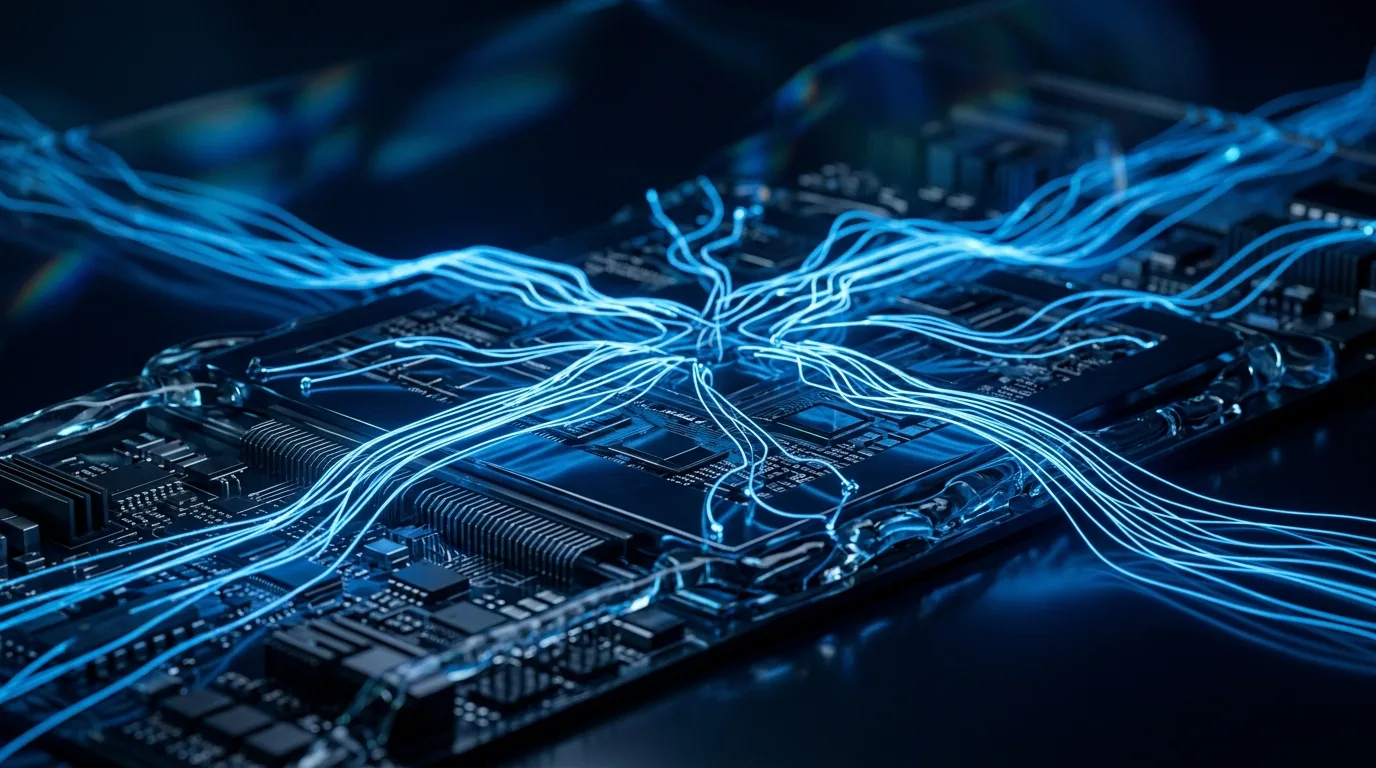

In the heart of a modern data centre in Poznań, a computing system is being installed that will soon process billions of parameters simultaneously. This is not science fiction - it is the Piast AI Factory, the result of a 143-million-dollar investment that shows that owning AI infrastructure is no longer the privilege of technology giants alone. In an era when every organisation is asking “how do we make use of AI?”, the answer is increasingly: build your own AI Factory.
Why infrastructure has become the heart of AI transformation
A traditional data centre was designed to host applications and store data. An AI Factory is something fundamentally different - it is an intelligence production facility, where the raw material is data and the product is AI models capable of reasoning, analysis, and real-time decision-making.
The difference is not merely semantic. NVIDIA, which has radically reshaped the AI computing landscape, defines an AI Factory as specialised infrastructure designed to produce intelligence at scale - from data acquisition, through model training and fine-tuning, to high-throughput inference. Unlike traditional data centres, an AI Factory is designed from the ground up for the intensive computational workloads characteristic of AI tasks.
“The difference between a traditional data centre and an AI Factory is like the difference between a craftsman’s workshop and a modern production line,” says Jacek Bugajski, CEO of SNOK. “In the former, you have general-purpose tools; in the latter, every piece of infrastructure is optimised for a specific task: producing intelligence.”
The scale of this transformation is remarkable. According to industry research, 80-90% of AI computing power is currently used for inference, not training. This means organisations need infrastructure that can not only train a model, but above all handle millions of queries per day with minimal latency.
The Polish context: why owning infrastructure is not a choice, but a necessity
For Polish organisations, particularly in the public sector, the question of owning AI infrastructure has both a business and a strategic dimension. Public institutions in Poland cannot - for legal and security reasons - use public cloud resources to process sensitive data. The requirement for on-premise environments is not an option here, but a fundamental requirement.
This explains why Microsoft has invested PLN 2.8 billion in expanding its cloud and AI infrastructure in Poland by June 2026. It explains why Poland, together with the Baltic states, applied to the European AI Gigafactory programme, which envisages the construction of 4-5 full-scale AI Factories, each equipped with at least 100,000 GPUs and valued at EUR 3-5 billion. It also explains why, in March 2025, the European Commission’s EuroHPC selected Poland as one of the locations for the Gaia AI Factory - a project intended to accelerate the development and adoption of advanced AI technologies in our country.
“For the Polish market, especially the public sector, sovereign AI infrastructure is not a luxury - it is a regulatory and strategic necessity,” explains Michał Korzeń, CTO of SNOK and Enterprise & AI Architect. “Sensitive data, particularly in public administration, healthcare, or defence, must remain within controlled, local environments. An on-premise AI Factory is the only route to harnessing the full potential of AI while preserving data sovereignty.”
The concept of Sovereign AI - a country’s capacity to produce artificial intelligence using its own infrastructure, data, and competencies - has become a global priority. Countries from India to Italy are investing in local supercomputers and AI Factories. Italy is developing the Modello Italia LLM language model on the Leonardo supercomputer. India is building large-scale AI infrastructure based on the NVIDIA GH200 Grace Hopper Superchip. Even Canada has allocated 705 million dollars to its AI Sovereign Compute Infrastructure programme.
The Polish data centre market is expected to reach 500 MW by 2030 and 1,200 MW by 2034. PSE, the transmission grid operator, has already reserved this capacity in its development plans. These are not abstract projections - this is a real transformation of the country’s digital infrastructure.
Anatomy of an AI Factory: from silicon to intelligence
Building an AI Factory is not just about purchasing GPU-equipped servers. It is the orchestration of an entire technology stack, where every layer - from silicon to software - is optimised for AI.
The hardware layer: a new generation of computing power
The foundation is the NVIDIA Blackwell architecture - the latest generation of chips designed specifically for AI. The GB200 Grace Blackwell chipset delivers 25 times the energy efficiency of the previous Hopper generation in AI inference tasks. This is not an incremental improvement - it is a technological leap. Over the past eight years, NVIDIA has improved the energy efficiency of large language model inference 45,000-fold. If cars had improved their efficiency at the same rate, they would travel 280,000 miles on a single gallon of fuel - enough to reach the Moon.
Lenovo ThinkSystem - as an NVIDIA partner - delivers hardware platforms integrated with this technology. The ThinkSystem V4 series, with Intel Xeon 6 processors and Blackwell architecture, offers up to 6.1 times the computing performance of the previous generation. Servers such as:
- SR680a V4 – equipped with eight NVIDIA Blackwell B200 GPUs and six Intel Xeon 6 processors with 288 cores, achieving up to 11 times faster inference than previous generations
- SR675 V3 – with AMD Instinct MI325X and an AMD EPYC 9005 processor, offering up to five times the performance while reducing energy consumption by 40% thanks to Lenovo Neptune liquid cooling technology
Lenovo Neptune liquid cooling is not an add-on, but a necessity. A single H100 GPU has a rated thermal design power (TDP) of around 700 watts. In a cluster with hundreds or thousands of such chips, traditional air cooling ceases to be effective. Neptune increases thermal efficiency 3.5-fold, reduces energy consumption for cooling, and enables consolidation of existing infrastructure at a 3:1 ratio - three five-year-old racks can be replaced with a single modern one.
The network layer: bandwidth without compromise
AI requires enormous bandwidth. Training a large language model involves a continuous exchange of gigabytes of data between thousands of GPUs. NVIDIA Spectrum-X is a network with bandwidth tailored to AI, ensuring that the bottleneck is not communication but actual computing power.
The BlueField-3 DPU (Data Processing Unit) offloads networking tasks from main processors and can reduce energy consumption by as much as 30%. This does not sound impressive until we multiply it by thousands of nodes in a cluster - then the difference becomes critical.
The software layer: from raw data to production models
Hardware is the foundation, but without the right software it is just expensive metal. NVIDIA AI Enterprise and the NeMo framework form a complete software stack for the entire AI model lifecycle.
NVIDIA NeMo is a modular, scalable platform for managing the lifecycle of AI agents. It includes:
- NeMo Curator – curation and preparation of training data at petabyte scale
- NeMo Framework – training, fine-tuning, and reinforcement learning for multimodal models
- NeMo Retriever – RAG (Retrieval-Augmented Generation) models delivering 50% better accuracy and 35 times better storage efficiency
- NeMo microservices – ready-made API services for rapid deployment and customisation of models
Amazon used the NeMo framework to train its next generation of Amazon Titan models. ServiceNow, together with NVIDIA and Accenture, launched the AI Lighthouse programme to accelerate the development of enterprise generative AI capabilities. Hyundai Motor Group is building advanced AI models with NeMo for over-the-air updates in its vehicles.
“NeMo democratises access to advanced AI,” comments Michał Korzeń. “Previously, training your own large language model required a team of dozens of specialists and months of work. Today, with the right infrastructure and NeMo, an organisation can train and deploy a model tailored to its needs in weeks rather than years.”
The economics of an AI Factory: numbers that convince CFOs
Investing in an AI Factory is a strategic decision requiring a solid business case. The good news is that return-on-investment cases are becoming increasingly compelling.
NVIDIA cites an example: a 5-million-dollar investment in a GB200 NVL72 (a complete rack-level system) generates 75 million dollars in token revenue - a 15-fold return on investment. This ROI reflects deep co-design across the Blackwell architecture, NVLink scaling technology, and optimisation tools such as NVIDIA Dynamo and TensorRT LLM.
Research by Microsoft and IDC shows an average return of 3.50 dollars for every dollar invested in AI. More importantly, 92% of AI deployments now take less than 12 months - a radical change compared to the multi-year projects of the past.
Practical examples from industry show concrete figures:
- Georgia-Pacific achieved a 30% reduction in unplanned downtime through AI based on SAS Viya on AWS
- Epiroc deployed an AI Factory in just 60 hours, using the Enterprise Scale Machine Learning framework on Azure, leading to consistent improvements in steel quality and waste reduction
- A household appliance manufacturer reduced defects by 30% in the first six months, saving 500,000 dollars on rework and waste
- Toyota reduced 10,000 labour hours annually thanks to an AI platform running on Google Cloud infrastructure
“ROI in AI is not just about cost savings,” notes Jacek Bugajski. “Above all, it is about the ability to do things that were previously impossible. A customer that predicts failures before they occur, production that adjusts to demand in real time, business models that are impossible without AI. This is not an investment in efficiency - it is an investment in competitive advantage.”
Energy and sustainability: myth and reality
The topic of AI’s energy consumption raises understandable concerns. Forecasts suggest that by 2030-2035, data centres could consume as much as 20% of global electricity. But the sheer scale of consumption does not tell the whole story.
Firstly, the energy efficiency of AI is improving rapidly. NVIDIA’s GB200 Grace Blackwell offers 25 times better energy efficiency than the previous generation in inference tasks. Murex, a Paris-based financial services firm, tested the NVIDIA Grace Hopper Superchip on its workloads - achieving a 4-fold reduction in energy consumption and a 7-fold improvement in performance compared to CPU-only systems.
PayPal, deploying NVIDIA GPUs for fraud detection, improved detection by 10% while reducing server energy consumption almost 8-fold. Research by MIT Lincoln Laboratory shows that limiting GPU power to 150 watts (instead of the full 700W) extends BERT model training time by only two hours (from 80 to 82 hours), while saving energy equivalent to a week’s consumption of an average American household.
Secondly, a new generation of energy management solutions is emerging. Emerald AI is developing software to control power consumption during peak grid demand. In field tests in Phoenix, Arizona, the company demonstrated that its software can reduce the energy consumption of a 256-GPU NVIDIA cluster by 25% for three hours during peak demand, while maintaining computing service quality.
A Duke University study estimates that if new AI data centres could flexibly reduce energy consumption by 25% for two hours - fewer than 200 hours a year - they could unlock 100 gigawatts of new capacity, equivalent to over 2 trillion dollars in data centre investment.
The NVIDIA Omniverse DSX blueprint - a comprehensive framework for building and operating gigawatt-scale AI Factories - uses digital twins and AI agents to optimise power and cooling. DSX Boost, one of its pillars, delivers up to 30% higher GPU throughput within the same power envelope.
“Energy efficiency is not an add-on - it is a fundamental design criterion,” Michał Korzeń stresses. “Organisations building AI Factories today cannot afford to ignore this issue, both from the perspective of operating costs and environmental responsibility.”
How SNOK shows clients that their own AI Factory is not science fiction
At SNOK, we know that the gap between theoretical knowledge of AI and a practical AI Factory deployment can seem enormous. That is why our approach is to show clients concrete, proven implementation paths.
As a partner of SAP, Microsoft, UiPath, NVIDIA, Lenovo, Intel, and Google Cloud, we have access to the latest technologies. The NVIDIA Enterprise AI Factory Validated Design is a complete blueprint - from the hardware layer (RTX PRO Servers, Spectrum-X networking) through software (AI Enterprise, NeMo), to orchestration and monitoring tools.
For a client in the manufacturing sector, we began by analysing specific use cases: predictive maintenance, production process optimisation, and automated quality inspection. We then designed a modular infrastructure based on Lenovo ThinkSystem SR675 V3 with AMD Instinct MI325X - powerful enough to get started, but with the ability to scale as use cases matured.
“We don’t ask clients ‘do you want an AI Factory?’,” explains Jacek Bugajski. “We ask: what business problems do you want to solve? Where are you losing time, money, competitive advantage? Then we show how AI infrastructure can solve those problems. An AI Factory is not an end in itself - it is a means to achieve concrete, measurable business outcomes.”
For a client in the financial sector, the key requirement was full control over customer data and compliance with GDPR and banking sector regulations. We designed an on-premise environment with air-gapped deployment - fully isolated from external networks, with complete auditability of every operation. This is the Sovereign AI approach in practice.
How to get started: three steps to your own AI Factory
Step 1: Identify use cases and estimate ROI
Do not start with the technology - start with business problems. Where can AI generate the greatest value? Which processes are most costly? Where is competitive advantage being lost?
High-ROI areas in practice include:
- Predictive maintenance (30% reduction in unplanned downtime in industry)
- Automated quality inspection (30% reduction in defects within 6 months)
- Supply chain optimisation and demand forecasting
- Customer service process automation
- Real-time anomaly and fraud detection
Step 2: Choose the deployment model and architecture
Three main models:
- On-premise – full control, essential for the public sector and regulated industries
- Hybrid – combining public cloud power with on-premise handling of sensitive data
- Edge AI – inference close to the data source (factories, shops, vehicles)
Architecture can start modestly - with a single Lenovo SR650a V4 server with four GPUs - and grow modularly. The key is designing for scalability from day one.
Step 3: Implement with a credible partner
Building an AI Factory is not just about purchasing hardware. It involves integrating the entire technology stack, tuning it to specific workloads, training the team, and implementing security and governance best practices.
Working with a partner such as SNOK, which has experience delivering implementations for the Polish market, understands local regulatory requirements, and has direct access to manufacturers’ know-how, dramatically reduces risk and accelerates time-to-value.
The future is already happening
Microsoft is investing PLN 2.8 billion in Polish cloud and AI infrastructure. Poland is competing for a multi-billion-euro AI Gigafactory. Local companies such as Epiroc are deploying AI Factories in 60 hours, achieving measurable returns in months rather than years.
This is not a distant future. It is happening now. Organisations that invest in sovereign, efficient AI infrastructure today will shape the markets of tomorrow. Those that wait will be chasing the competition.
“An AI Factory is no longer a luxury available only to technology giants,” Jacek Bugajski concludes. “It has become a real, achievable option for organisations of every size in Poland and across Europe. The question is no longer ‘can we afford an AI Factory?’. The question is: ‘can we afford not to have one?’.”
SNOK supports Polish organisations in their digital transformation - with a team combining 25+ years of cumulated experience in enterprise technologies. As a partner of SAP, Microsoft, NVIDIA, Lenovo, UiPath, and other technology leaders, we combine global expertise with a deep understanding of the local market. Let’s talk about how an AI Factory could become your competitive advantage.
document.getElementById(“page”).classList.add(“newLayout”);
Would you like to see this in practice or discuss an implementation for your organisation? Get in touch – we will respond within 48 hours.