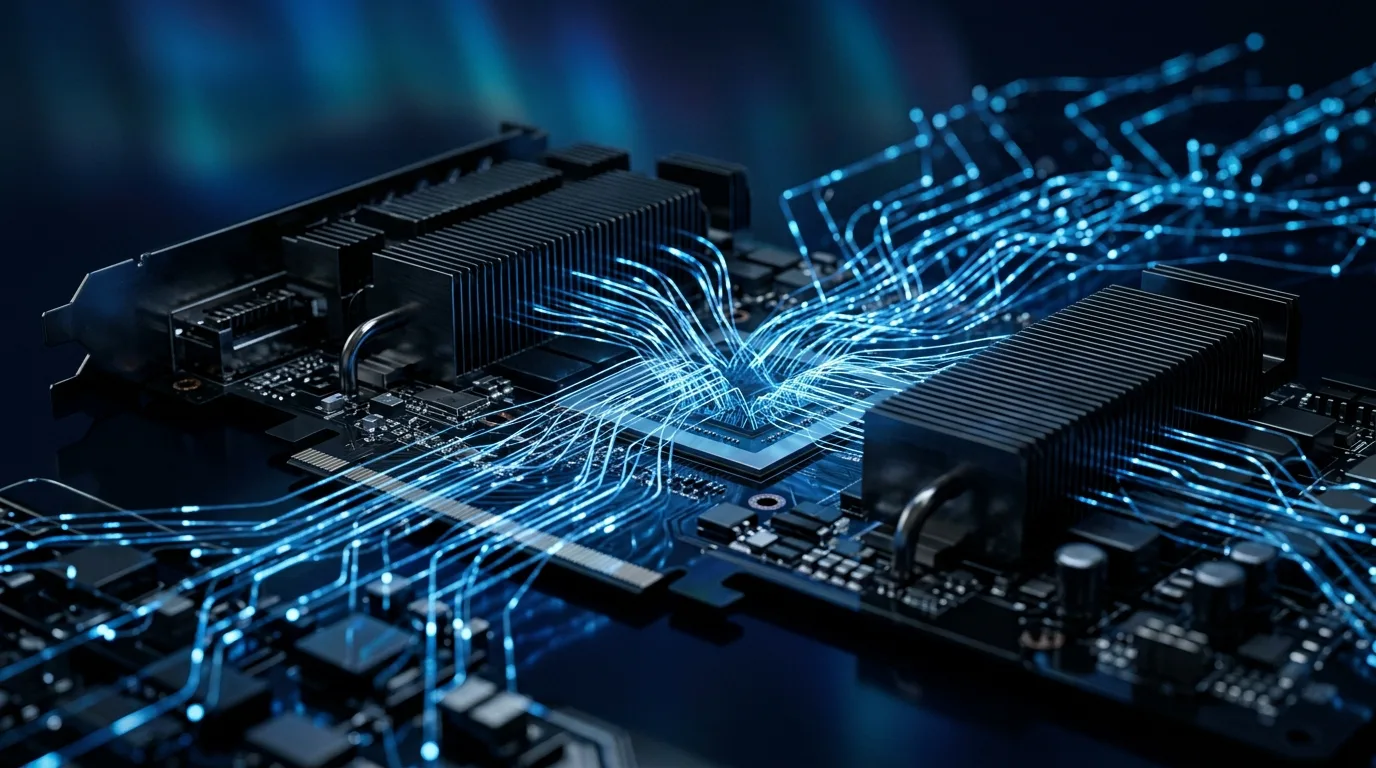

From 17 to 21 March 2025, one of the world’s most important technology conferences is taking place -NVIDIA GTC 2025. This exceptional event brought together industry leaders, researchers, entrepreneurs and technology enthusiasts, all exploring together the future of artificial intelligence and its applications. Here is a summary of the key trends and announcements from this year’s edition.
A turning point in AI development
The NVIDIA GTC 2025 conference, held in San Jose, California, showed that we are at a pivotal moment for artificial intelligence. Jensen Huang, founder and CEO of NVIDIA, emphasised in his keynote that we have reached a “trillion-dollar tipping point” in the development of AI technology.
“We are at a point of investment worth more than a trillion dollars in AI infrastructure. Accelerating demand for AI computing, driven by the growth of AI reasoning and AI agents, is transforming data centre investment around the world” - said Huang.
Blackwell architecture – a new era of performance
The central point of the conference was the announcement that NVIDIA Blackwell is now in full production. This groundbreaking architecture delivers up to 40 times higher performance compared with the previous Hopper generation, representing a significant step forward in AI development.
Blackwell significantly improves both AI model training and inference, enabling more efficient and scalable artificial intelligence applications. Alongside the new architecture, NVIDIA also presented NVIDIA Dynamo - open-source software that accelerates and scales AI reasoning models in AI factories.
It was also announced that the second half of the year will see a new evolution of the AI factory platform based on NVIDIA Blackwell - Blackwell Ultra, which will further increase training and inference capabilities in AI applications.
Technology roadmap and regular updates
NVIDIA has introduced an “annual rhythm” - essentially a roadmap of updates for the development of AI infrastructure. Each year is set to bring new GPUs, CPUs and improvements in accelerated computing, including the forthcoming NVIDIA Vera Rubin architecture, designed to increase the performance and energy efficiency of AI data centres.
The announcement of NVIDIA Isaac GR00T N1
One of the most exciting announcements was the introduction of NVIDIA Isaac GR00T N1, the world’s first open, fully configurable foundation model for generalised reasoning and humanoid skills. This is an important step forward in robotics, particularly in the context of Huang’s forecast that, by the end of the decade, the world will face a shortage of at least 50 million workers, underlining the growing importance of automation.
Focus on health and energy
The conference also showcased significant advances in AI applications in the healthcare and energy sectors:
-
Kimberly Powell, Vice President of Healthcare and Life Sciences at NVIDIA, presented nine major announcements, including the new NVIDIA DGX Spark AI supercomputer and the NVIDIA AgentIQ platform.
-
Emphasis was placed on the role of accelerated computing in medical imaging and genomics, as well as the introduction of the world’s largest biology foundation model, Evo 2, trained on 9 trillion nucleotides.
-
EPRI, NVIDIA and partners launched the Open Power AI Consortium, aimed at transforming the future of the energy sector.
Partner ecosystem and support for start-ups
NVIDIA expanded the benefits available to start-ups under the NVIDIA Inception programme, offering eligible members up to $100,000 in NVIDIA DGX Cloud credits for dedicated NVIDIA H100 GPU capacity.
Members approved for this benefit will also gain access to experts who provide technical support. The NVIDIA Partner Network (NPN) programme recognised 14 leading partners in the Americas for their work on the development of agentic and physical artificial intelligence across various industries.
Conversations with AI leaders
The conference also featured inspiring conversations between industry leaders. Bill Dally, NVIDIA’s chief scientist, and Yann LeCun, chief AI scientist at Meta and professor at New York University, shared their vision for the future of AI.
LeCun predicted that artificial general intelligence (AGI) would be achievable within 3-5 years. He also emphasised the importance of open-source projects in supporting the development of diverse AI assistants.
AI in film production and entertainment
Haohong Wang, CEO of TCL, spoke about how AI-powered tools such as Runway, Sora and MineStudio enable faster workflows, new artistic possibilities and a more accessible future for content creators.
Wang predicts that budgets for AI-generated content could enable film-quality content to be made for less than 10% of today’s costs, making high-quality storytelling accessible to a wider range of filmmakers.
Jacek Bugajski, CEO of SNOK, commenting on the announcements from the conference, highlighted the role of AI in robotics as a key element of the future:
“AI-powered robotics is not just about improving efficiency, but a fundamental shift in how business operates. At SNOK, we believe that integrating advanced AI with robotic solutions creates an unprecedented opportunity to accelerate economic development and address global challenges. Companies that do not invest in this technology now risk being left behind by this revolution.”
SNOK, with AI embedded not only in its domain expertise but also in its organisational foundations, consistently monitors the evolution of the latest technology trends. The company systematically analyses and deploys advanced artificial intelligence solutions, focusing on implementations with measurable business value that transform operations and increase clients’ competitiveness in a dynamically changing market.
Summary
The NVIDIA GTC 2025 conference confirmed that we are entering a new era of artificial intelligence, in which traditional data centres are evolving into entire AI factories, producing intelligence at an unprecedented scale. Blackwell architecture, AI reasoning models, humanoid robots and the integration of AI across various industries point to a future in which artificial intelligence will play a key role in solving humanity’s greatest challenges.
For companies such as SNOK, which prioritise innovation and technological progress, the conference confirmed the chosen direction of development, focused on practical applications of AI in robotics and business process automation.