

Within six days, two companies from entirely different market segments - UiPath and SAP - announced essentially the same move. On 12 May, UiPath introduced native integration of its platform with Claude Code and OpenAI Codex. On 13 May, at the Sapphire conference in Orlando, SAP presented Joule Studio 2.0, in which AI agents are built as code, pushed to GitHub, and opened in VS Code with any coding agent - including Claude.
This is not a coincidence. The era of the “bare coding agent” in the corporation has just ended. The era of the governance layer has begun - the layer that decides whether code written in 10 minutes makes it into a production environment.
Below we break down both announcements, their common denominator, and what wasn’t said out loud on the keynote stages - namely the costs and limitations worth knowing before signing a contract.
What exactly was announced
12 May: UiPath for Coding Agents
UiPath - listed on the NYSE under the ticker PATH, one of the leading companies in agentic business orchestration - published an announcement of the launch of “UiPath for Coding Agents”. The premise is as follows: any coding agent (initially Anthropic’s Claude Code and OpenAI Codex, with further integrations announced for 2026) generates automation code in natural language. The UiPath platform takes over this code, wraps it in its own orchestration and governance layers, and then deploys it as part of an enterprise workflow.
The vendor argues bluntly that despite the popularity of coding agents, in enterprises “they largely exist in isolation, cut off from corporate developer workflows, security policies, code review processes and deployment pipelines”. In operational terms - a developer writes something with Cursor or Claude Code, gets a script that works locally, and then hits the wall of corporate IT processes. UiPath proposes that this wall disappear, because the orchestration platform itself handles the audit trail, role-based access control, credential vault and runtime policies.
According to the vendor, the orchestration layer is “constant” - independent of which coding agent (or which successive model version from Anthropic, OpenAI or Google) generated the code, or which human last modified it.
13 May: SAP Joule Studio 2.0 and the Autonomous Enterprise
A day later, at the Sapphire conference in Orlando, SAP CEO Christian Klein opened his keynote with a provocative question: “Will SAP remain a software company in the future?” He then offered his own answer: SAP is becoming a “business AI company”. Alongside this identity shift came several technical specifics - a new unified architecture called the SAP Business AI Platform (combining SAP BTP, SAP Business Data Cloud and AI Foundation), a package of more than 50 Joule assistants spread across finance, supply chain, HR and CX processes, and Joule Studio - an environment for building custom agents.
The most interesting development for the IT consulting industry turned out to be how the new Joule Studio works. According to Thomas Jung of SAP, presenting the news live to developers in Orlando, the tool generates a code-based agent approach. In other words - what you build in Joule Studio can be pushed straight to a GitHub repository, opened in Visual Studio Code, and further developed with any third-party coding agent, including Claude. SAP integrates with other solutions via MCP servers (Model Context Protocol).
On top of this came announcements of ABAP for VS Code, an ABAP MCP server, integrations of SAP Build Code with the agentic platform, a partnership between Microsoft and SAP for sovereign cloud (live in Germany, France and the UK, with the US and Japan by the end of 2026 - Poland is not on the map for the initial rollout), and a €100 million fund for partners deploying the Business AI Platform.
Why it’s the same move
Setting aside the technological differences and marketing positioning, both announcements say essentially the same thing. Code for automating business processes in the enterprise will be written by agents. But only code that passes through the governance layer will make it into production.
Why does this matter? Because in 2024 and 2025 the market lived on the hype of “every developer will get a Copilot and we’ll code 10× faster”. That was true - but only at the level of the individual developer. At the organisational level, it turned out that writing code faster accounts for less than 20% of the full cycle. The rest is: code review, testing, security scanning, deployment, monitoring, change management, audit trail. Without this, a coding agent generates files that either never make it into production, or do, but create risks the organisation does not control.
“Agentic AI is not the next RPA. It is a paradigm shift - the bot doesn’t execute instructions, it makes decisions within defined guardrails. Without those guardrails, we get a chaos generator running with administrator privileges.”
Michał Korzeń, CTO, SNOK Sp. z o.o.
UiPath and SAP - even though one sells process orchestration and the other ERP - are seeing the same thing. Value is shifting from code generation to orchestration and control. The coding agent becomes a component in a chain, not an end product. This is a meta-trend that will define the next 24 months in enterprise automation.
Three consequences for the market:
First - the integrator’s role is growing, not shrinking. Contrary to the narrative that “AI will replace consultants”, the consulting market is simply shifting its centre of gravity. Less coding from scratch, more designing guardrails, policies and review processes. A consultant who knows SAP Basis and can also design an audit trail for an agent is rarer and more expensive today than 18 months ago.
Second - sovereign data is back on the contractual agenda. Earlier in May, UiPath announced agentic AI on Automation Suite with a self-hosted LLM option. SAP and Microsoft launched sovereign cloud with confidential computing in Germany, France and the UK. The reason is simple - NIS2, DORA and the AI Act and national critical-cybersecurity laws. Data processed by an agent in a US public cloud is a regulatory problem for a bank, an insurer, or a public-sector entity. A vendor that has no answer to the question “where physically does the LLM run while performing this task” is eliminated from a tender already at the qualification stage.
Third - coding agents are becoming a commodity; governance is not. All serious players (Anthropic, OpenAI, Google, Mistral) will quickly deliver comparable models. Differentiation is shifting to the control, audit and compliance layer. SAP has officially listed Anthropic, Mistral and Cohere as sovereign model options on its infrastructure - meaning the choice of model itself is becoming a configuration parameter, not a strategic purchasing decision.
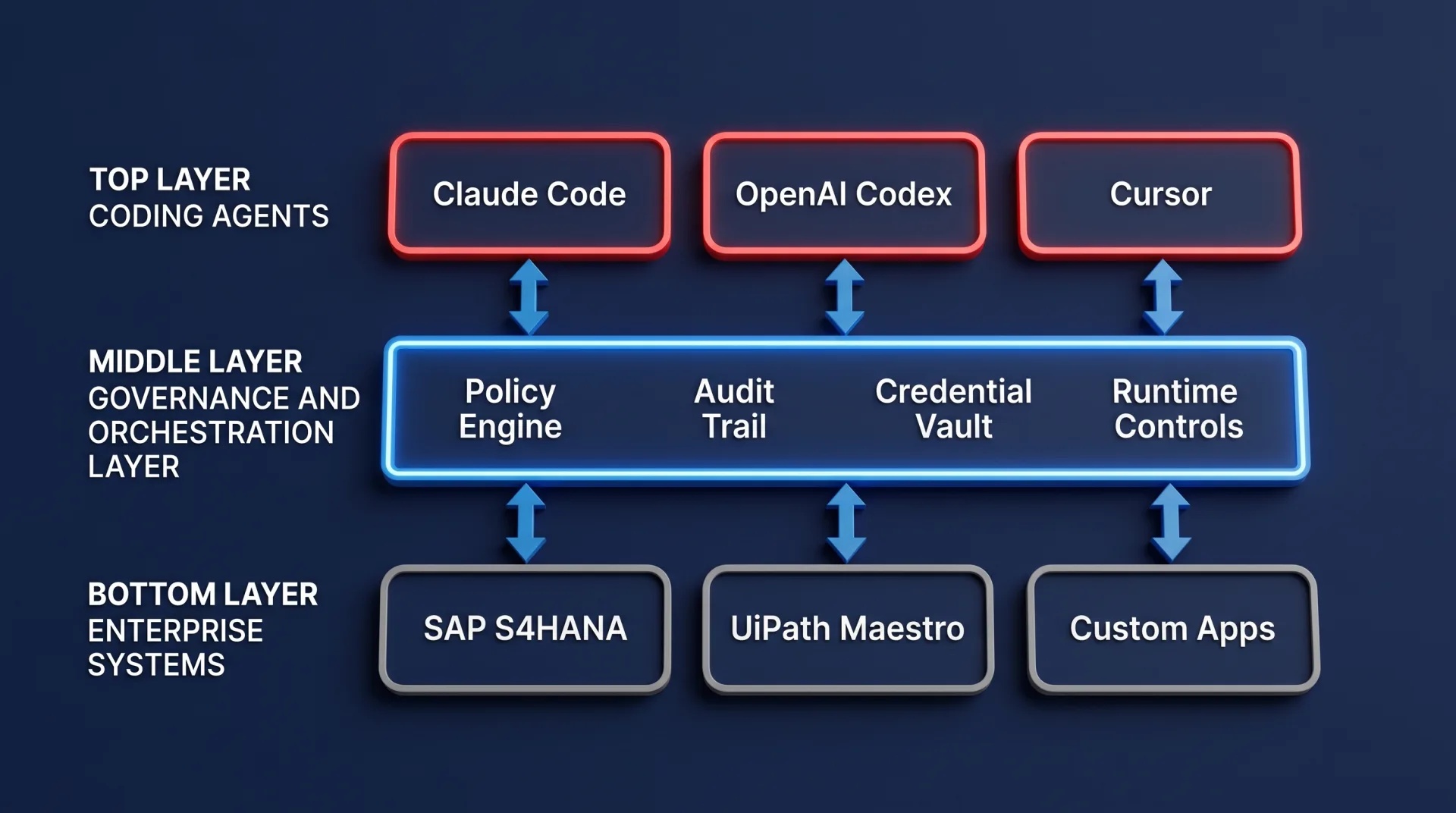
Diagram: layered architecture of the new generation of enterprise automation. Coding agents create code, the governance layer decides what goes into production, enterprise systems execute.
Architectural decisions to make before signing a contract
The announcements from market giants are easy to grasp in theory. The difficulty begins with a concrete architectural decision. Every CIO who, after Sapphire 2026, adds “we’re moving to the autonomous enterprise” or “we’re piloting UiPath for Coding Agents” to the roadmap should first answer five questions.
First - where does the agent end and the human begin. Regardless of the marketing, every agent needs Human-in-the-Loop gates at critical points in the process. The question is not “whether” but “at which step” and “who exactly approves it”. Failing to make this decision is a guaranteed incident within the first six months of going live.
Second - where physically does the data processed by the agent reside. If the LLM is in a public cloud in a different jurisdiction, and the agent processes personal, financial or other sensitive data while executing a task, there is a potential problem with GDPR, DORA or NIS2. SAP and UiPath offer self-hosted or sovereign cloud options, but this requires separate infrastructure and budget decisions.
Third - what does the audit trail look like, and who uses it. Every action taken by the agent must be logged in a way that allows the full chronology to be reconstructed: what input, what rules, what model decision, what output, who had the permissions. These logs must be available to the auditor, the security operations centre and - in the event of an incident - the regulator. According to an IBM report from December 2025, 13% of companies experienced an AI-related incident, and 97% of them admitted they lacked proper access controls for agents. This scale points to systemic neglect, not a statistical anomaly.
Fourth - who is liable for an agent’s error. The question seems academic until an agent books an incorrect invoice for half a million złoty or approves a transaction that exceeds a limit. In contractual practice, it must be decided whether liability rests with the platform vendor, the integrator, or remains with the client. This also affects insurance - most cyber policies currently exclude damage caused by autonomous AI systems from their default scope.
Fifth - what does the exit strategy look like. Vendor lock-in with orchestration platforms is deeper than with a CRM or ERP alone, because agents are integrated into business processes. Migrating from one orchestration platform to another in three years’ time will be a multi-month project. It is worth understanding now what a definition dump of agents looks like, whether an interoperability standard exists (the Model Context Protocol is a step in this direction, but not yet an industry standard), and how long a vendor would need for a collaborative offboarding.
The sceptical section - what wasn’t said out loud on the keynote stages
The most interesting moment of Christian Klein’s keynote in Orlando was not the announcement of Joule Studio or the Business AI Platform. It was the moment when the SAP CEO himself said, to paraphrase: “simply connecting AI agents to your system will not generate value”. And he added: “Moving to the Autonomous Enterprise requires serious change management. AI adoption goes hand in hand with changing business processes and preparing end users.”
That single sentence is worth printing and pinning above the desk of every consultant who, over the next twelve months, will be designing an agent deployment. Because this is not what the marketing slides or the vendor case studies say - the vendor itself admitted that technology without process and without people ready to change how they work delivers no result.
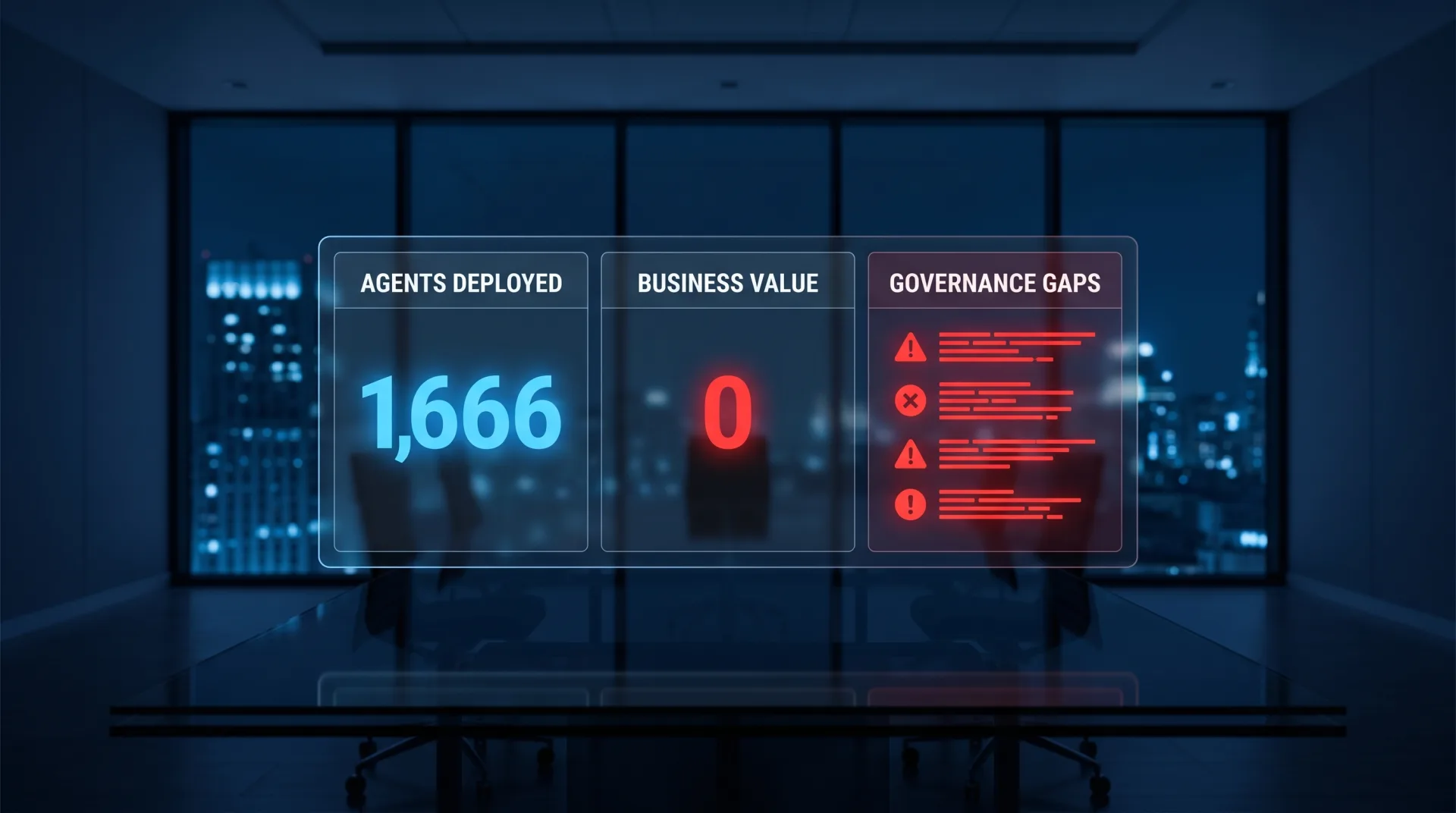
A second sceptical point: according to Accenture and Wipro reports cited by UiPath, 70 to 80 percent of agentic initiatives had not reached production scale by the end of 2025. The reason does not lie in the technology. The demo works; the deployment does not always. The reasons are usually the same: no defined “as-is” process before automation, no business owner on the client side, no real budget for change management.
Third - the Polish context of sovereign cloud. SAP and Microsoft are launching sovereign cloud in Germany, France and the UK. The US and Japan are expected to follow by the end of 2026. Poland’s public and regulated sector - banking, energy, public administration, healthcare - does not appear on the map for the first rollout. This does not mean Polish companies have no options - SAP RISE and Azure have regions in Poland, and sovereign cloud is not the only route to data residency. But it does mean that a client wanting sovereign cloud in the SAP/Microsoft variant will either have to wait, or choose the German region with additional regulatory risk.
“In every technology hype cycle I see a recurring pattern. First the vendor shows a demo that solves a problem the client doesn’t have. Then the client asks whether it works in their environment. And that’s when it turns out a project needs to be run. It’s the same with agentic AI. Three platform changes won’t replace one sound discovery.”
Jacek Bugajski, CEO, SNOK Sp. z o.o.
What this means for a mid-sized Polish company
For organisations with 500-3,000 employees considering a move into agentic automation in 2026, the announcements from the second week of May should reframe the internal discussion from “which vendor” to “which architecture”.
A practical list worth discussing at the next technology committee meeting:
Process inventory. Before considering a platform, it is worth taking stock of which processes are genuinely suited to agentic automation. Criteria: repeatability, exception volume, criticality, availability of data in structured form. Processes with three exceptions per hundred cases are suited to classic RPA and do not require an agent. Processes with thirty exceptions per hundred cases may require an agent - or may first require simplification of the process itself.
The orchestration platform decision. The choice between UiPath and SAP is not binary. Companies with a strong SAP core position (S/4HANA, BTP) naturally lean towards Joule Studio for agents within SAP business processes. Companies with a large cross-system estate (CRM, ERP, custom apps, partner integrations) usually choose UiPath as a neutral orchestration layer. In practice, many organisations will use both - SAP for agents inside the SAP ecosystem, UiPath for cross-system orchestration. This increases complexity, but is pragmatic.
AI Security review before the PoC, not after. A security audit of an agentic system should be part of the design phase, not a post-deployment step. Audit scope: prompt injection vectors, the “lethal trifecta” (model + external content + sensitive tools), access scope, RAG security, source-aware access control, logging, MCP server security. For regulated sectors (banking, insurance, energy, public sector), compliance with NIS2/DORA/AI Act is not optional - it is a statutory requirement, with penalties of up to €10 million or 2% of global turnover.
A pilot with an ROI counter from day one. The first agentic project should have a defined business KPI measured before and after deployment. Without this, a year on the organisation will have agents but no proof of value, and will not make a decision about scaling.
An adoption plan, not just an implementation plan. Klein was right. Without change management and user preparation, an agent stands unused. Investment in communication, training and rolling adoption should account for at least 20% of the project budget - less than that risks the technical project ending while the organisational one does not.
Perspective
A coding agent that generates automation code in natural language is not hype. It is a real change in how software gets built inside an enterprise. But it is also not magic that removes the need for architectural and process thinking.
Vendors in May 2026 said what the market is beginning to expect. Coding agents are fast, but without governance they are a regulatory, operational and financial risk. The orchestration, audit and policy layer is becoming the main differentiator, not the AI model itself.
For a Polish company in 2026, this means two things. First - the window for a pilot deployment of agentic AI is open, and the platform is mature. Second - the quality bar for projects is rising. A deployment without an audit trail, without RBAC policies, without a compliance plan for NIS2 and the AI Act, is no longer a deployment. It is an experiment that will sooner or later meet a regulator.
The good news is that the market is talking about this openly. The bad news is that the number of projects that fail to clear this bar in 2026 will be higher than in any previous IT hype cycle.
Would you like to see this in practice or discuss implementation at your company? Contact us - we respond within 48 hours.
About the author: SNOK Sp. z o.o. (Warsaw) is an IT consulting firm specialising in SAP, cybersecurity, UiPath automation and custom development. UiPath Platinum Partner and Agentic Fast Track Partner. Certified to ISO 27001:2023 and ISO 9001:2015. In agentic AI, we advise clients in banking, energy, manufacturing and the public sector - from the discovery phase through deployment and ongoing support.